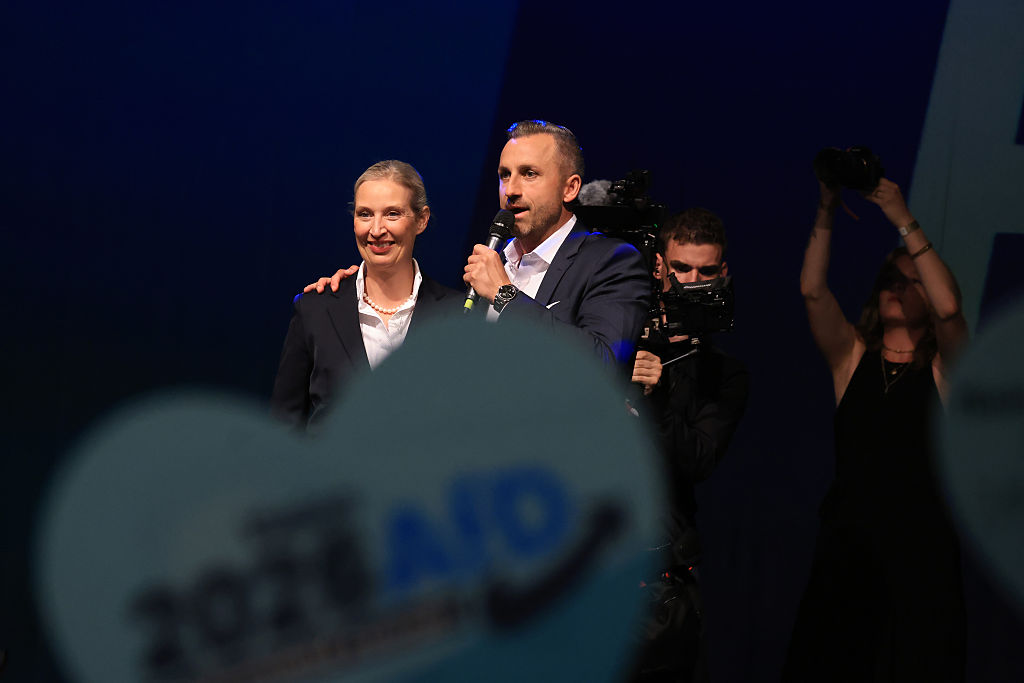
Germany’s Alternative for Germany (AfD) is poised to finish ahead of rivals in a state election, coming closer than any other far-right party in the country to governing at a regional level since World War II. The party won 44% of the vote in Saxony-Anhalt’s state election on Sunday, according to provisional results. By comparison, center-right CDU, the party of Chancellor Friedrich Merz, won less than 20%.
The state of 2.1 million people saw a record voter turnout of 77%. But the party faces an uncertain path towards power. Without an absolute majority, it would need a coalition partner or support from lawmakers outside the party to form a government—something that German mainstream parties have thus far refused to provide.
Nevertheless, the surge in support for the AfD, which ran on a platform of restricting immigration, ending aid to Ukraine, and taking Germany out of the euro, is remarkable in a country where the legacy of Nazism has long kept the far right at the political margins. The party’s Saxony-Anhalt branch is classified by the state’s domestic intelligence as “right-wing extremist,” a designation that its leaders reject. President Donald Trump posted a screenshot of the projected results without comment on Truth Social.
Members of Trump’s Administration, including Vice President J.D. Vance, previously expressed public support for the party. Tech billionaire Elon Musk, who spoke at AfD’s campaign launch last year, congratulated AfD co-leader Alice Weidel on the projected win.
In response, Siegmund thanked him “for your support” and said he would “welcome the opportunity for strong and constructive cooperation.” Russian presidential envoy Kirill Dmitriev posted a screenshot of Trump’s post. He said in the caption,“Historic win for the pragmatic AfD that will put migration under control. The ruling Bidenthink coalition eviscerated,” referring to former U.S.
President Joe Biden, a Democrat. The AfD is friendly to the Kremlin and has advocated for Germany to end support for Ukraine. Invoking the collapse of the communist regime in East Germany and the fall of the Berlin Wall, Herbert Kickl, leader of the right-wing Freedom Party of Austria (FPO) said, “As of today, the strong wind of freedom from 1989 is blowing through Germany once again.” Other European leaders expressed alarm over the result.
Extract — continue reading at the source.