So many artists have created their life’s work after decades of toiling in the lab like a mad scientist. But when it comes to video games, a laborious life cycle rarely results in a masterpiece. Due to rapidly changing tech, a game that’s in development for a decade can often wind up dropping as a Frankenstein monster built from the bones of shifting design trends and hardware changes.
So it’s a miracle that Faraway, a game that’s been in development for closer to twenty years than ten, lands as a little triumph. Faraway is the latest game from Steph Thirion, the solo developer behind 2009’s critically acclaimed iOS puzzler Eliss. (It’s published by Annapurna Interactive, the company arguably best-known for publishing offbeat games for wider audiences.) At a distance, Faraway looks like a small project: a high-score chasing arcade game about shooting stars. In reality, it’s a 16-year passion project that has finally come to fruition.
Even in its one-button simplicity, Faraway feels like the kind of small-scale masterwork that so often gets overlooked in an industry that increasingly values Hollywood production over expressive gameplay. Like a classic arcade game, Faraway doesn’t need much explanation. You control a shooting star floating through space in a straight line.
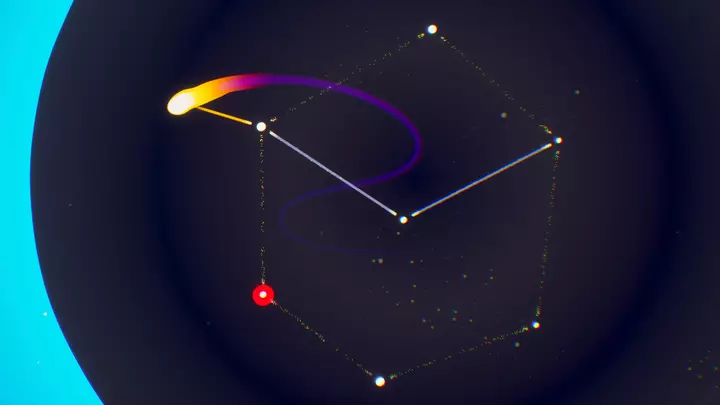
When you press and hold the game’s single button while passing by a star, you’ll snag onto it and orbit around it until you let go. That allows you to change directions and build speed as you hurtle through space. You’ll need to master those fundamentals before you get to Faraway’s delightful puzzle conceit: Your goal is to create as many constellations in the sky as you can before time runs out.
As you fly around, you’ll bump into round zones that contain a bunch of stars. Using your orbiting powers, you can connect lines from one star to the next. A constellation is made by linking together as many stars as possible without intersecting with an existing line.
You’ll get points for each line segment placed, but you’ll get an added score multiplier each time you create a closed loop of stars. The more complex your constellations, the more points you’ll get. Plus, you’ll add more time to your star’s short lifespan and unlock larger zones that let you make even bigger constellations as a round goes on.
Extract — continue reading at the source.