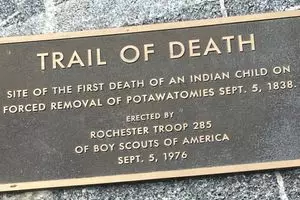
Most Popular PlacesRandom PlaceListsItinerariesAdd a PlaceDownload the App First Death Marker on the Trail of Death Hunebed D27 Grotta Tanaccia PDX Carpet Memorial Where to See the World’s Most Famous Preserved Body Parts 6 days ago Atlas Obscura’s Guide to America’s Most Haunted Cemeteries 13 days ago The Best Haunted Hotels to Book for a Spooky Getaway 22 days ago All the United States Indiana First Death Marker on the Trail of Death In 1838, 859 Potawatomi Indians were forcibly removed from their village to begin a grueling march to Kansas. This location marks the first death. Flowers thoughtfully left by a visitor lewdinih / Atlas Obscura User Flowers thoughtfully left by a visitor lewdinih / Atlas Obscura User Flowers thoughtfully left by a visitor lewdinih / Atlas Obscura User Flowers thoughtfully left by a visitor lewdinih / Atlas Obscura User The first death during the forced removal and march was that of a child on September 5, 1838.
This is a small portion of the tragic story of greed, western expansion, and lies that became known as the Potawatomi Trail of Death. On September 4, 1838, 859 Potawatomi Indians were forced to begin a 660-mile march from Twin Lakes, Indiana, near present-day Plymouth, to a reservation in what is now Kansas. The march lasted until November 4, 1838, with 42 Potawatomi dying along the way.
Conditions were harsh and grueling. Water was scarce, and without enough horses, even the elderly were forced to walk. The promised wagons never arrived.
Sixty-one brutal and tragic days later, they arrived in Kansas. The State of Indiana and the federal government desired to expand westward through northern Indiana. In 1832, construction of the Wabash Canal had begun in northern Indiana, with the plan to connect it with the Erie Canal.
White settlers were moving into the area, and lands the Potawatomi lived on were now needed by the government. Although many Potawatomi had already moved peacefully west, on August 5, 1838, Chief Menominee and his tribe at Twin Lakes remained steadfast. This date was the deadline to leave the lands, as set in a treaty from August 5, 1836.
Chief Menominee never signed the treaty and claimed the signatures were forged. Indiana Governor David Wallace sent General John Tipton with a militia to surround the village and forcibly remove Chief Menominee and his band. On September 4, 1838, the march began when the militia burned the crops and the village so there would be nothing left if the people attempted to return.When they arrived at Pottawattomie Creek in present-day Osawatomie, Kansas on November 4, 1838, the Indian Agent and the promised cabins were not there.
Extract — continue reading at the source.