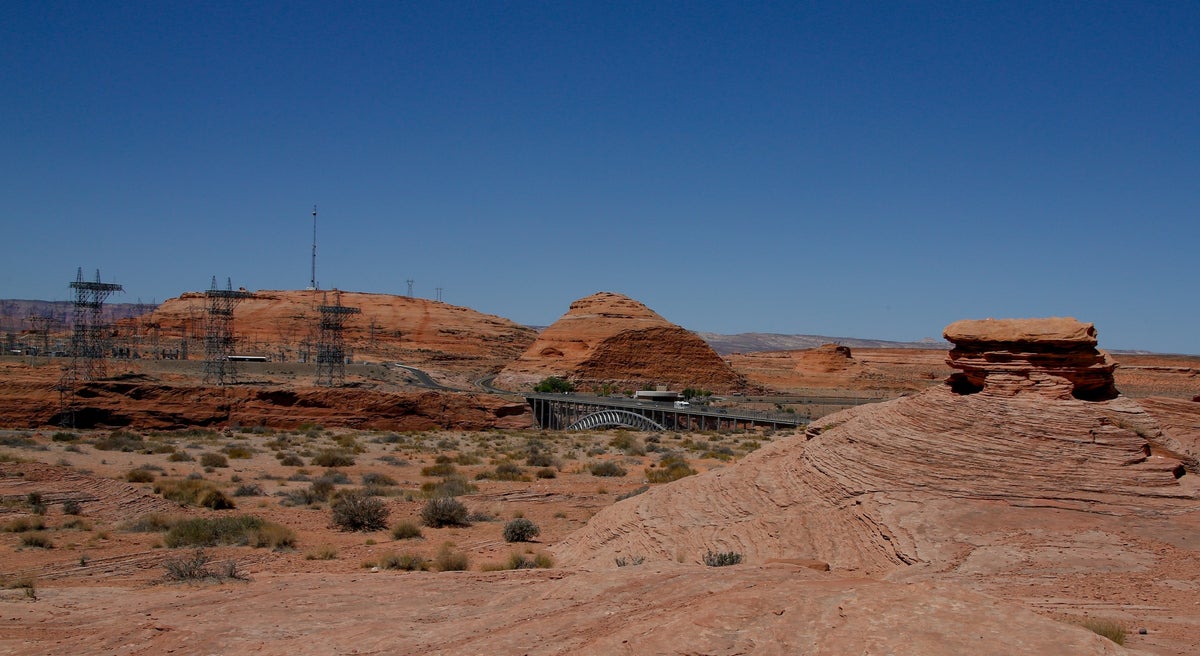
Glen Canyon Dam rises above the Colorado River near Page, Arizona. The National Park Service temporarily closed nearby Chains Road and The Chains day-use area after workers discovered detonation cord dating to the dam's original construction in the 1950s and 1960s. ( ) In a span of days, federal officials had to deal with explosives that were found at National Park Service sites on opposite sides of the country. On Oct. 30, the National Park Service announced in a public alert that workers had discovered detonation cord near Glen Canyon Dam in Arizona, temporarily closing a recreation area at Lake Powell.
The release said the cord was likely left over from the dam’s construction in the fifties or sixties. That closure came shortly after an Oct. 21 announcement from officials at Maryland’s Antietam National Battlefield, where Marine Corps technicians removed unexploded Civil War-era cannonballs that were embedded in the monument’s concrete base. While incidents like these are rare, the Park Service has developed procedures for dealing with the discoveries of unexploded munitions or construction explosives.
In 2022, the agency began reviewing museum collections for potentially explosive ammunition, according to information officials provided to The Herald-Mail. That same year, NPS published guidance for handling historic munitions, followed by additional safety procedures in 2023 after an investigation involving the transportation of a live 19th-century cannonball from Fort Larned. Workers found several boreholes containing detonation cord along a restricted service road near Glen Canyon Dam, outside Page, Arizona.
The cord is a flexible line filled with high explosives used to initiate blasting charges, according to the National Institute of Standards and Technology. An explosive ordnance disposal team traced the material to the dam’s original construction in the 1950s and 1960s. Officials said there was no threat to public safety and the dam faced low risk, but closed Chains Road and The Chains day-use area while evaluating mitigation options.
The closure restricts access to a popular shoreline spot for swimming, fishing and picnicking, though the wider national recreation area remains open. The discovery points back to one of the most ambitious engineering projects in the American West. Construction on the 710-foot-tall Glen Canyon Dam began in 1956, requiring crews to blast diversion tunnels through sandstone canyon walls and excavate foundations down to bedrock.
The project began with a dramatic display of patriotic pyrotechnics on Oct. 15, 1956, when President Dwight D. Eisenhower pressed a telegraph key in Washington, D.C., remotely triggering the first dynamite blast at the site, according to the Bureau of Reclamation. Nearly 70 years later, the newly discovered detonation cord has brought explosives specialists back to the area, although officials have not linked it to Eisenhower’s ceremonial blast.
Extract — continue reading at the source.