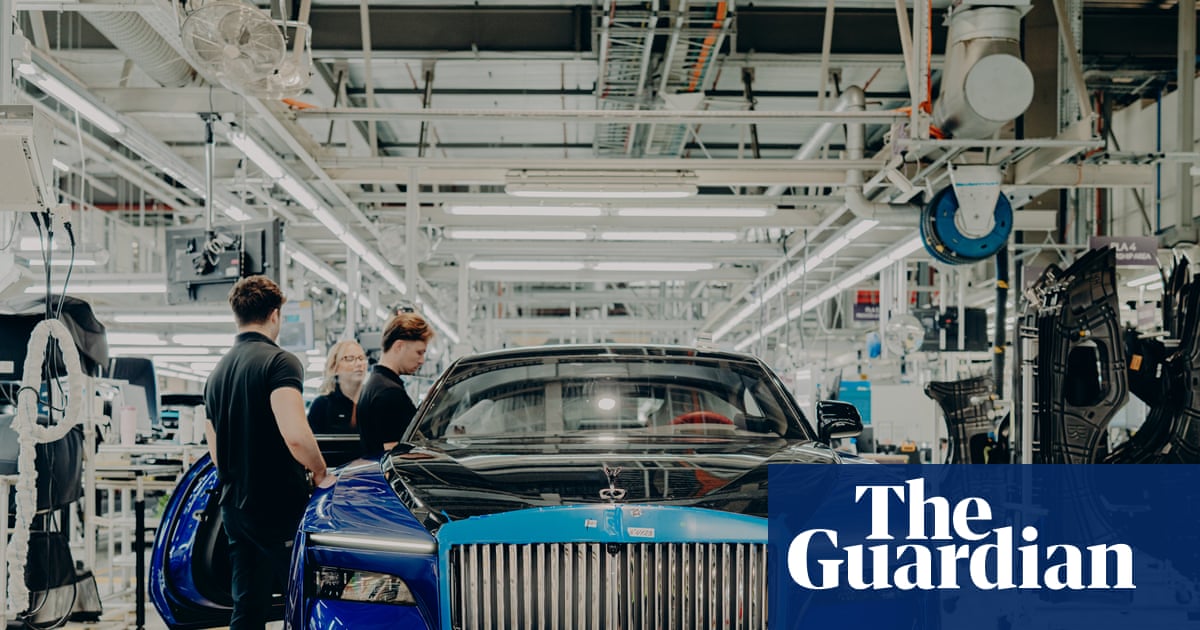
They are the plaything of kings, presidents and A-listers, with Rolls-Royce enthusiasts ranging from the Sultan of Brunei to Rowan Atkinson, from King Charles III to Kermit the frog. And at the carmaker’s factory in Goodwood, West Sussex, special requests from customers get more indulgent every year. An interior lined with 3,000 iridescent feathers, or a built-in champagne cooler, or a car built in homage to its owners’ dog, have all become part of the job.
Even with a fast-growing team of artisans and engineers, the company is stretched, and soon it will nearly double the size of its factory as part of a £300m investment by its owner, BMW, which it said at the time of the announcement was part of “securing our future here in the UK”. Behind much of the demand is a new kind of client, who is younger than ever and with a fortune built in technology, says Julian Jenkins, Rolls-Royce’s director of sales and brand. The average buyer is now just 43 – down from 56 in 2010.
Bespoke, high-value customisation is becoming an increasingly valuable pillar of UK manufacturing, which still makes up about 9% of the UK economy despite the years of deindustrialisation that Andy Burnham has vowed to reverse. This week, the wider sector helped drive a surprise expansion of GDP in August, after growing 0.8% month on month. On a tour of the Goodwood factory, an inner door panel is emblazoned with a bitcoin symbol, hinting at changing tastes.
The dog’s face was pieced together on a rear panel using more than 180 individual slivers of wood, which was a four-month project, with paw prints engraved in the doors for good measure. Clients nowadays, Jenkins says, “are creating something in their image”. Four models make up the current Rolls-Royce range: the Phantom, starting at £441,000, the nearly three-tonne Cullinan SUV, from £345,000, the Spectre electric car, from £333,000, and the cheaper Ghost, from £290,000.
But the average Rolls-Royce sells for about £500,000, up from about £300,000 a decade ago, driven largely by customisation work. A heavily personalised car can cost 25% more than the standard price, and seven-figure sums are “not unusual”, a spokesperson says. With that, there is value that comes as a consequence.” It is a vision Rolls-Royce’s founders could scarcely have imagined for a company that staked its early reputation on reliability.
The business dates back to 1904, when Charles Rolls, an aristocrat and racing driver, met Henry Royce, an engineer, at the Midland Hotel in Manchester, and agreed to sell every car the latter could build. By 1907, Autocar magazine called the Silver Ghost, an early model, the “best car in the world” after completing the gruelling Scottish Reliability Trial without a single mechanical fault. Now, Rolls-Royce has its own entry in the Collins dictionary, as a byword for “anything considered to be the very best of its kind”.
Extract — continue reading at the source.