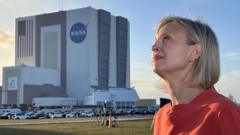
For the last 10 days, four astronauts have been making history, travelling further into space than humans have been before as they voyaged to the Moon and back. I've been following every moment of the Artemis II mission: from lift off, to their lunar close encounter and a nerve-shredding landing. Before they blasted off into space, the crew told us that on launch day astronauts are the calmest people around.
My excitement was impossible to contain and as the rocket fired its huge boosters and engines and headed skywards, my reaction went viral. Standing by the countdown clock at the Kennedy Space Center in Florida, alongside my BBC News science team Alison Francis and Kevin Church, was a truly visceral experience. The burning white brightness you just can't take your eyes off, the deafening roar that takes seconds to hit you, and the force of the blast that passes right through you.
Most of all though, I just couldn't quite grasp that there were four human beings strapped into their seats at the top of a 98m-tall rocket on their way to the Moon. As Reid Wiseman, Victor Glover, Christina Koch and Jeremy Hansen got their first look at home from far above, Glover told the world: "Planet Earth, you look beautiful." Then with a burn of their spacecraft's main engine, they said goodbye and began their quarter of a million mile journey to the Moon. With the crew getting used to microgravity, live video was streamed back to Earth from inside their capsule.
And it was immediately clear how crammed together they were. They were living, working, eating and sleeping in a space about the same size as a minibus. There was no privacy from each other, or from the millions of people around the world following every twist and turn.
Particular attention was paid to their Universal Waste Management System, otherwise known as the loo. Their troublesome toilet, which cost $23m to design, had problems with its plumbing. And we got to find out, in intimate detail, about the impact this was having on the astronauts, when questions were asked at a media briefing about the status of their "number ones and number twos".
And if you want to know - and, confession, I really did - it was "go" for "number twos" but for "number ones" collapsible contingency urine devices were deployed. Basically bags with funnels. At the Johnson Space Center in Houston, we got to spend time in mission control - the nerve centre of the entire operation.
Extract — continue reading at the source.