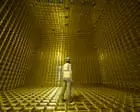
For more than a century, the mining town of Lead, in the Black Hills of South Dakota, attracted workers with a taste for gold. Now, a flagship experiment being built in the old mine is drawing scientists in search of more intriguing riches: answers to the deepest mysteries of the universe. Construction of the Deep Underground Neutrino Experiment (Dune) in the former Homestake mine is due to start on Monday.
Engineers will begin assembling four giant detectors inside caverns blasted from rock a mile underground. Once switched on, the detectors will quietly spark and flicker as ghostly particles called neutrinos hurtle through them. Some will arrive from the sun and distant supernovae, others in an intense beam sent through 800 miles (1,300km) of rock from a government laboratory near Chicago, Illinois.
Observing the neutrinos could uncover entirely new science and shed light on cosmic spectacles, such as the death of stars and the birth of black holes. Scientists are particularly hopeful of solving one of the most enduring puzzles in nature: why everything around us is made from matter and not its “evil twin”, antimatter. In other words, why we, and why anything, is here at all.
They are produced in natural nuclear reactions, such as those that power the sun, in radioactive decay and in particle accelerators. Even by physicists’ standards, neutrinos are oddballs. The chargeless particles barely interact with other matter: about a trillion pass unnoticed through your body each second.
Neutrinos come in three varieties, all with minuscule but different masses. Weirdly, they change from one variety to another, a process called oscillation, as they travel. In the 1960s, the physicist Ray Davis followed miners down the shaft and built a detector from a 100,000-gallon tank filled with dry-cleaning fluid.
Shielded so deep beneath the ground, the detector became the first to record neutrinos from the sun as they struck chlorine atoms in the fluid and turned them into argon. The mine closed in 2001 and transitioned, thanks to visionary forethought, into a dedicated subterranean laboratory, the Sanford Underground Research Facility (Surf). It is already home to the Lux-Zeplin (LZ) experiment which last month reported the first potential detection of dark matter.
Extract — continue reading at the source.


