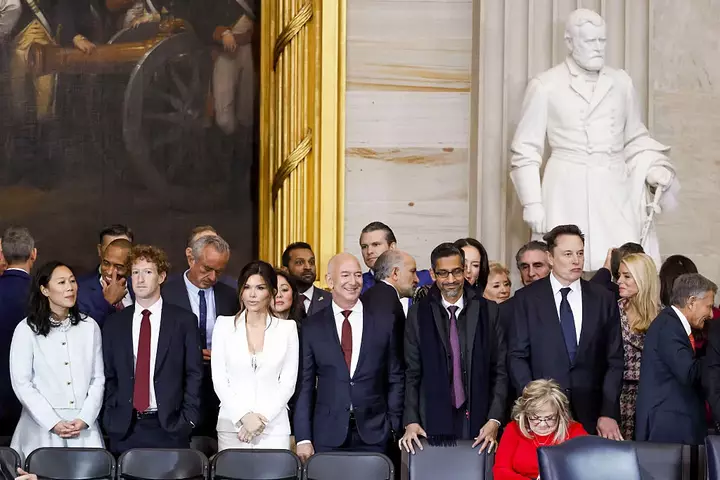
Right before the midterm elections, OpenAI hired Jessica Schumer, daughter of Democratic Sen. The company also said it would start calling its data centers “compute campuses.” For the past two years, many of Silicon Valley’s biggest names have built closer ties with President Donald Trump and his administration. Several attended White House events, some companies scaled back diversity, equity and inclusion programs, and some executives donated millions to super PACs supporting his campaign and allied candidates.
Administration policies also benefited the industry, including tax breaks, the pausing of some federal investigations, and looser AI regulation. Meanwhile, Meta faced lawsuits and billion-dollar fines, and OpenAI faced suits alleging its technology harmed users. Now, with the midterms shifting the balance of power in Washington, those same companies are working to rebuild ties with Democrats, who have pledged to tighten oversight of AI.
How far that gets them may depend less on image-polishing than on where the real fights are happening: in state capitols, in communities deciding whether to host data centers, and, as we’ve seen this past week, in the markets watching the AI boom. Branch, director of federal AI governance and technology policy at Public Citizen, a nonprofit advocacy group that describes itself as nonpartisan, told me that the tech industry “realizes they have an optics problem.” He characterized moves like the Schumer hire and the rebranding as “PR washing.” He expects more of it, too, pointing to OpenAI’s partnership with the American Federation of Teachers, announced last year, as well as Anthropic’s newly launched Claude Corps and Meta’s America’s Workforce Academy. These initiatives didn’t spring up overnight.
Meta and other tech companies reportedly began looking for ways to strengthen their ties to Democrats as Democratic gains in the midterms looked more likely. Reached for comment about the midterm elections’ impact on Meta, a company spokesperson pointed TechCrunch to remarks that Meta President Dina Powell McCormick made this week at WSJ Tech. Alice Marwick, director of research at the tech policy nonprofit Data & Society, told me she expects Big Tech to try to pivot back toward the middle, “if not the left.
But it’s a little too late,” she said. Data center moratoriums are gaining traction, and a wave of AI regulation bills awaits drafting. At the same event, Powell McCormick said Meta wants to show that communities welcoming its investments will see “an enormous amount of benefit,” while those that don’t want them “will of course have the right to stop them.” Still, the next two years could bring political gridlock in Washington.
Aryan Ranjan, founder of Baraza, a political campaign management software company, told me most action will likely happen at the state level, since states have already sued tech companies and passed regulations. Last December, the Trump administration signed an executive order creating the AI Litigation Task Force, a federal group meant to challenge state AI laws. The administration has argued that U.S.
Extract — continue reading at the source.