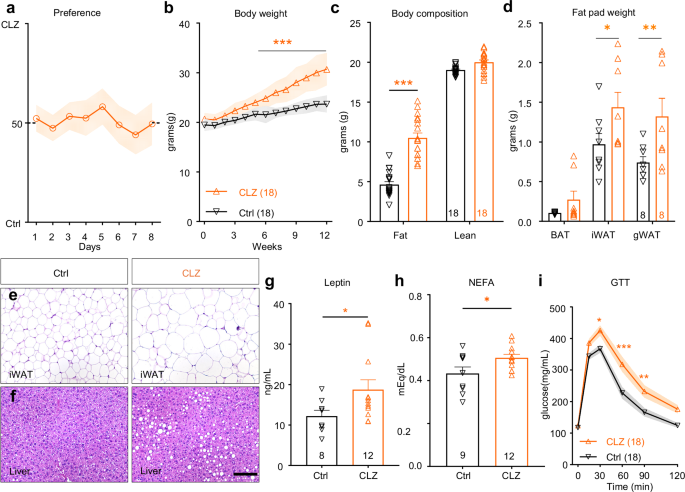
Most antipsychotic drugs (APDs) cause hyperphagia and weight gain, yet the neural mechanisms underlying these metabolic side effects remain elusive, in part due to difficulties in modeling them in rodents. Here, we establish a mouse model that recapitulates clozapine-induced metabolic syndrome, enabling mechanistic investigation of this widely prescribed APD. We show that clozapine promotes obesity in female mice by driving hyperphagia, which requires functional coupling between the melanocortin 4 receptor (MC4R) and the Kir7.1 potassium channel.
Within the broader context of clozapine’s polypharmacology, this signaling axis emerges as a critical downstream convergence node for APD-induced metabolic dysfunction. Mechanistically, clozapine inhibits MC4R-expressing neurons in the paraventricular nucleus of the hypothalamus by enhancing MC4R-Kir7.1 coupling, thereby increasing inward potassium currents. Notably, clozapine produces this inhibition without binding the MC4R orthosteric site and without engaging canonical Gαs signaling.
Genetic deletion of Kir7.1 in MC4R neurons or pharmacological inhibition of Kir7.1 reverses clozapine-induced weight gain while preserving its behavioral efficacy in established antipsychotic assays. Together, these findings reveal a G-protein-independent mechanism by which clozapine disrupts energy balance and identify MC4R-Kir7.1 coupling as a therapeutically tractable pathway for mitigating APD-associated metabolic dysfunction. Antipsychotic drugs (APDs) demonstrate broad efficacy in treating diverse neuropsychiatric conditions1.
However, most APDs induce metabolic syndrome characterized by hyperphagia, weight gain, and insulin resistance2. Despite interventions such as lifestyle modification, nutritional counseling, and weight-loss pharmacotherapy3,4,5, these metabolic side effects remain difficult to manage and are a leading cause of treatment discontinuation. APDs act on multiple neurotransmitter receptors throughout the brain6,7,8 and this polypharmacology is central to both their therapeutic benefits and metabolic liabilities.
While their therapeutic efficacy primarily stems from blockade of dopamine D2 and serotonin 2a receptors9,10, the metabolic side effects of clozapine, olanzapine, and risperidone are thought to arise from convergent action across a broader receptor set that includes high-affinity antagonism at hypothalamic histamine H1, serotonin 5-HT2C, dopamine D2/D3, and muscarinic M3 receptors11,12,13,14,15, alongside effects on MC4R-dependent melanocortin signaling16. These actions are thought to perturb hypothalamic energy-balance circuits and promote hyperphagia and metabolic dysfunction17,18,19. Disentangling the contribution of any individual pathway within this polypharmacological landscape has remained a central challenge.
A major obstacle to mechanistic studies has been the inability to reliably reproduce these metabolic effects in rodent models. For example, clozapine, one of the most effective and commonly prescribed APDs, causes pronounced weight gain in both adolescents and adults20, yet chronic administration of clozapine to rodents via intraperitoneal injection or drinking water produces only modest effects on food intake and body weight21,22. In this study, we establish a mouse model that faithfully reproduces clozapine-induced weight gain and identify the interaction between the melanocortin-4 receptor (MC4R) and the Kir7.1 potassium channel as a key mediator of this effect.
Extract — continue reading at the source.