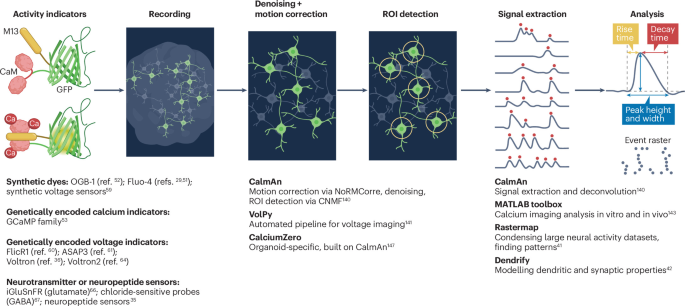
Human neural organoids have become powerful systems for investigating neural development, circuit formation and disease mechanisms in a species-specific context. Traditional animal models and two-dimensional cultures have long informed our understanding of neural activity, but they cannot reproduce the genetic, developmental and architectural complexity of the human brain. Neural organoids bridge this gap by enabling direct measurement of neuronal activity at cellular, ensemble and network scales.
Functional interrogation now spans calcium and voltage imaging, patch clamp electrophysiology, and multielectrode array recordings, enabled by bioengineering advances that improve organoid viability and electrode–tissue coupling. Multi-regional assembloid models and xenotransplantation approaches further extend functional maturation and enable investigation of inter-regional connectivity. The integration of computational frameworks with functional measurements also enables extraction of quantitative features such as excitability, synchrony and network topology, linking molecular programs to emergent circuit behaviour.
Furthermore, emerging studies demonstrate that neural organoids can exhibit synaptic plasticity, adaptive computation and goal-directed learning in closed-loop paradigms, opening research directions beyond spontaneous activity characterization. Functional organoids can also expand disease modelling by revealing mechanisms of network dysfunction across neurodevelopmental, neuropsychiatric and neurodegenerative disorders. Nevertheless, the absence of standardized benchmarks, reference datasets and reproducible analysis pipelines continues to limit comparability across studies.
This Review synthesizes current technologies and analytical strategies for probing activity in neural organoids; evaluates their translational relevance and limitations; and discusses how interdisciplinary integration of stem cell biology, bioengineering, systems neuroscience and computational modelling could establish robust frameworks for mechanistic and ethically grounded exploration of human brain function. Functional assays in neural organoids span optical and electrophysiological modalities (such as calcium and voltage imaging, patch clamp, and next-generation multielectrode arrays), requiring researchers to move beyond binary ‘active or inactive’ labels towards multi-state characterizations of network behaviour. Assay choice in organoids is shaped by 3D geometry, heterogeneity and tissue handling.
Accessibility-enhancing formats (slicing and surface coupling) improve signal quality but can alter microenvironment and connectivity, requiring careful interpretation and reporting. Multi-region assembloids and xenotransplantation provide complementary contexts for inter-regional connectivity and enhanced functional maturation, and can serve as practical benchmarks for in vitro maturation limits. Emerging demonstrations of synaptic plasticity and closed-loop paradigms (including adaptive computation and learning-like behaviours) extend organoid functional studies beyond spontaneous activity but remain technically and conceptually nascent and should be interpreted conservatively.
Transparent reporting and benchmarking resources, including organoid reference atlases, are needed for comparability. Ethical governance should be proactive and forward-looking as capabilities evolve, particularly as assembloid models increasingly incorporate components relevant to consciousness-related and pain-related circuitry. This is a preview of subscription content, access via your institution Receive 12 digital issues and online access to articles Prices may be subject to local taxes which are calculated during checkout Hodge, R.
Extract — continue reading at the source.


