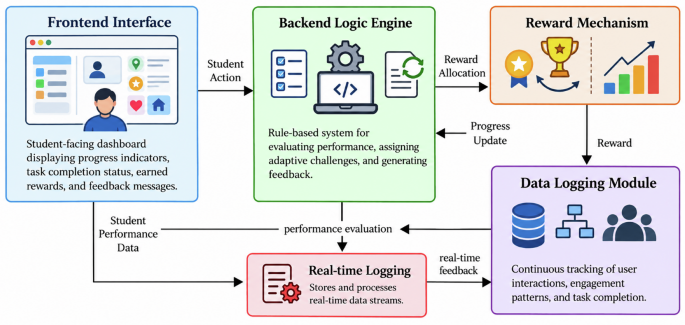
The integration of gamification in digital education has attracted significant attention as a strategy to enhance student engagement and learning outcomes. However, empirical evidence concerning its effects on retention and educational equity in real-world classroom settings remains limited. This study examines whether a gamified learning environment can improve engagement, retention-related outcomes, and academic performance compared with a non-gamified digital platform, and explores differences across diverse learner profiles.
A total of 100 secondary school students were divided into a gamified group (n = 50) and a non-gamified group (n = 50) and observed over an eight-week instructional period. The gamified system incorporated progression tracking, adaptive challenges, real-time feedback, and digital rewards within an existing learning management system. Engagement and retention-related outcomes were estimated using platform interaction logs and academic performance indicators.
Results indicate that students in the gamified group showed higher engagement, including greater login frequency, task completion, and interaction levels. Improvements were also observed in selected retention-related measures, including assignment completion and participation consistency. The findings further suggest that adaptive challenges and feedback may provide responsive support for learners with lower initial performance or engagement.
However, the effect of personalisation was not statistically isolated. Equity-related analyses indicated reduced disparities across selected socio-economic and demographic groups. Overall, it is concluded that well-designed gamification can strengthen student engagement and persistence while potentially contributing to more inclusive and responsive digital learning environments.
These findings provide empirical evidence that gamification can support engagement and retention-related outcomes in secondary education, while highlighting the need for larger, multi-school, and longitudinal studies to establish the sustainability of these effects and assess implications for educational equity. The fast digitalization of learning has essentially revolutionized the way teaching and learning take place in the 21st century. Digital learning has become a key element of the world education systems thanks to the rapid deployment of virtual classrooms, learning management systems, and online platforms, which have gained an unprecedented level of popularity especially due to the COVID-19 pandemic (Rincon-Flores et al., 2022).
As a result, students and teachers are becoming more dependent on online technology to facilitate remote and flexible learning conditions (Hong et al., 2024). Nonetheless, irrespective of its scalability and accessibility, the issue of digital education remains a severe and unresolved problem the ability to maintain meaningful student engagement and long-term retention of learning in various virtual space settings (Ortiz-Rojas et al., 2025). This is not only a pedagogical but also a socio-economic challenge.
Extract — continue reading at the source.