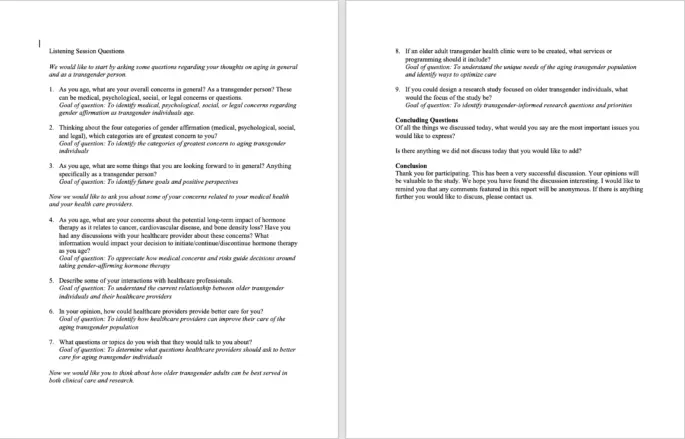
Older transgender persons are a specific minoritized population with unique health and care concerns. The needs and priorities of older transgender adults are poorly understood, likely due to implicit biases surrounding age, sexuality, and gender. Four listening sessions were conducted with transgender women, ages 55 years old and above, in the San Diego and Palm Springs area between August and November 2023.
Two sessions were held in-person in English, one was held virtually in English, and one was held in-person in Spanish. Individuals were recruited through local clinics, community-based organizations, and social media. All sessions were audio-recorded, transcribed, translated as needed, and analyzed using a rapid thematic analysis approach.
Nineteen individuals participated (median age 62 years, range 55–87). Of the 16 who completed the demographics questionnaire, all identified as transgender female and/or female. Four identified as Hispanic/Latinx, 7 as White, 1 as Black/African American, 1 as American Indian/Alaska Native, and 3 as mixed race.
Six were living with HIV and taking anti-retroviral therapy. Participants expressed concerns about aging, including companionship, financial security, access to routine healthcare maintenance screenings, and safe housing. These concerns were balanced by future aging goals like living authentically and mentoring younger generations. 75% were using gender-affirming hormone therapy (GAHT), and most shared frustrations with inconsistent provider guidance on GAHT duration, dosing, method of administration, and long-term risks.
Many viewed GAHT as essential, despite potential risks. While all participants reported positive and negative healthcare experiences, many emphasized a desire for providers to address mental and sexual health more openly and to be better informed about community resources. Older transgender adults represent a heterogenous population with distinct medical, psychological, and social needs.
Identifying their key concerns is essential to advancing patient-centered, transgender-informed research and improving care for this historically underserved population. The authors would like to thank and acknowledge the study participants for their time and contributions to this research. We also thank RP from the Transgender Health & Wellness Center and JA from Proyecto Trans Latinas for their roles in recruiting many of the participants of this study.
Extract — continue reading at the source.