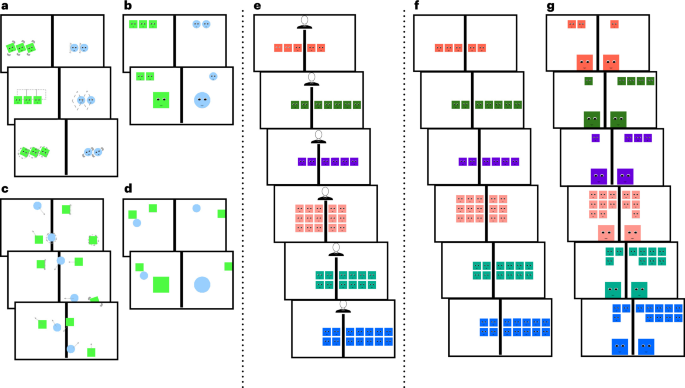
Recent decades have seen a surge of research revealing the core, early emerging psychological building blocks for navigating human societies. Yet, how such core motives operate across life, undergirding political ideology, remains unknown. Here we use the same kind of minimal, abstract group stimuli across the lifespan to show that gendered preferences for majority groups manifest among preschoolers and adults alike (but not among preverbal infants) and that they motivate support for sustaining intergroup hierarchies (for example, ethnic persecution, militarism and social welfare opposition) among adults.
Preschool (N = 317) boys, but not girls, preferred majority rather than minority members, whereas infants (N = 180) chose randomly between the two. Among adults (N = 3,467), males also liked the majority more than females, and these coalitional preferences correlated robustly with political ideology. These results indicate that gendered motives for intergroup formidability are rooted in earliest childhood once children begin navigating peer relationships independently.
This is a preview of subscription content, access via your institution Access Nature and 54 other Nature Portfolio journals Get Nature+, our best-value online-access subscription Receive 12 digital issues and online access to articles Prices may be subject to local taxes which are calculated during checkout All data are publicly available via OSF at https://doi.org/10.17605/OSF.IO/SYN3B (ref. 129). Source data are provided with this paper. JASP files with main analyses are available via OSF at https://doi.org/10.17605/OSF.IO/SYN3B (ref. 129).
W., Frenkel-Brunswik, E., Levinson, D. J., Sanford, N. & Gordon, P. The Authoritarian Personality (Verso, 2019).
Sidanius, J. & Pratto, F. Social Dominance Theory: An Intergroup Theory of Social Hierarchy and Oppression (Cambridge Univ. An integrative theory of intergroup conflict.
In The Social Psychology of Intergroup Relations (eds Austin, W. G. & Worchel, S.) 33–47 (Brooks Cole, 1979). The coevolution of parochial altruism and war.
Extract — continue reading at the source.


