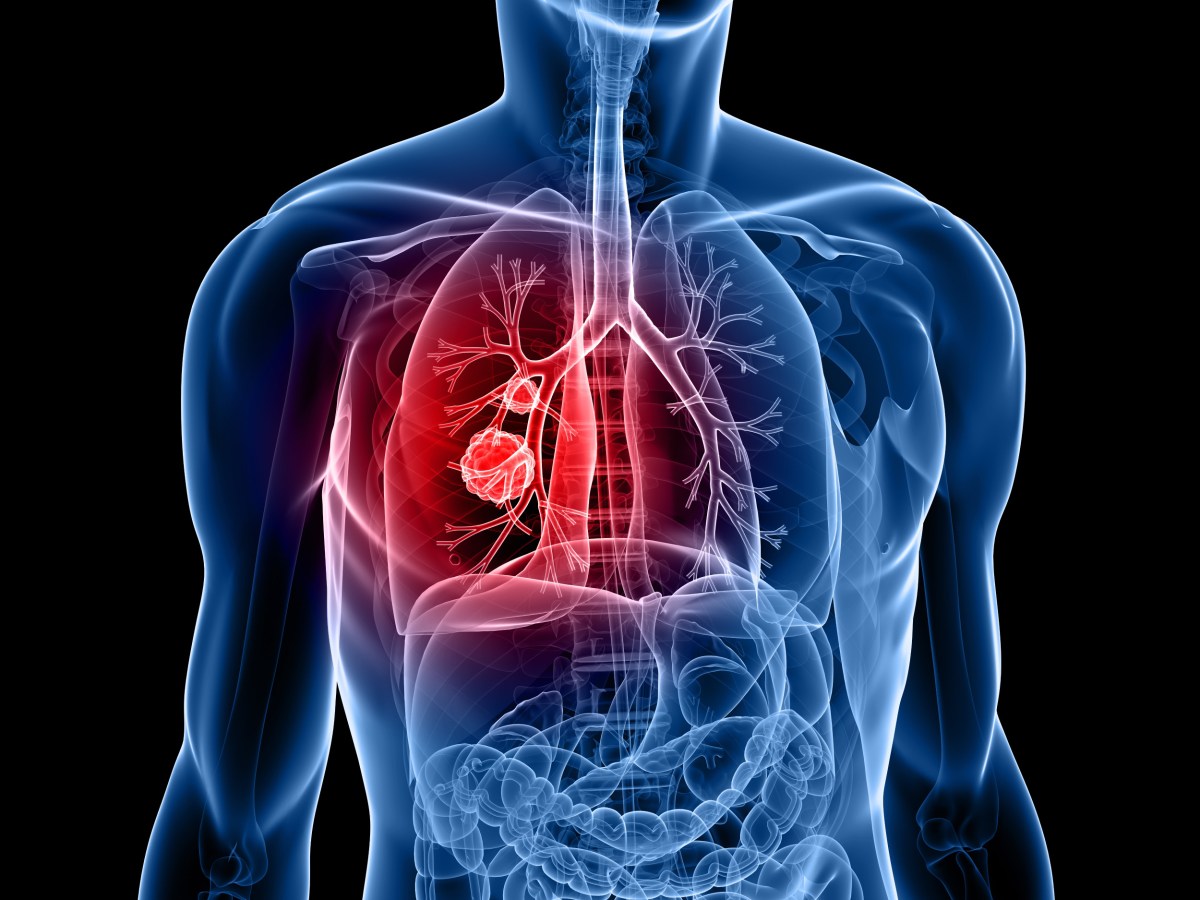
People who have never smoked may still be at a much higher risk of developing lung cancer if they have a certain rare genetic mutation. That's according to a new study, which suggests that carriers of the rare EGFR T790M mutation may have 62 times the risk of developing lung cancer than people who had never smoked. When accounting for both never-smokers and smokers, those with the mutation may still face roughly 25 times the risk of lung cancer.
Researcher Jaclyn LoPiccolo, MD, PhD, told Newsweek: "We tend to think of lung cancer risk primarily in terms of smoking and environmental exposures, but this study shows that, in some people, inherited genetics can also play a powerful role. "For most common diseases, inherited risk is generally spread across many genetic variants with small effects; here, a single inherited mutation was associated with a very large increase in lung cancer risk." Lung cancer is among the most common cancers in both men and women in the United States, with the American Cancer Society estimating there will be around 229,410 new diagnoses in 2026 alone. It is also the leading cause of cancer death in the U.S., accounting for about one in five of all cancer deaths.
Tobacco smoking is by far the leading risk factor for lung cancer, with around 80 percent of lung cancer deaths thought to arise by smoking. There are also risk factors that cannot be affected by lifestyle changes, such as air pollution and a family history of lung cancer. Inherited genetic factors—or a family history of cancer—are known to increase a person's risk of developing lung cancer, but are poorly understood.
Now, a study published in Science looked at the EGFR T790M mutation by analyzing genetic and health data from more than 3 million people, and found that this variant in the gene is strongly associated with lung cancer risk. The researchers were able to track the history of the mutation, and discovered that it may have come to the United States through the Southern Appalachian region around 200 years ago. LoPiccolo said: "We found that people who carry the inherited EGFR T790M mutation had approximately 25-fold higher odds of developing lung cancer than people without the mutation.
"The association was particularly striking among people who had never smoked, where those carriers in this study had more than 60-fold higher odds of lung cancer." They now hope that linking EGFR T790M to an increased risk of lung cancer may help identify patients who could benefit from genetic testing and lung cancer screening. Until now, the rarity of the gene means prior studies into the mutation have been limited, however researchers in this case had access to more than 3.3 million genotyped research samples. From this, they were able to calculate the cancer risk associated with the variant, taking into account smoking status, and evaluate its geographic distribution and geographic origins of the variant.
It found that the variant was present in around 1 in 15,850 participants, and that it is "significantly enriched" in the United States—with a carrier frequency of 1 in 8,920 in those descended from British and Irish populations and, later, of African and Indigenous American ancestry. This suggests that the mutation arose in Europe and was brought to the Southern Appalachian region by British and Irish settlers during the colonial era. LoPiccolo said there is much more still to be discovered about the mutation and what it means for carriers.
Extract — continue reading at the source.