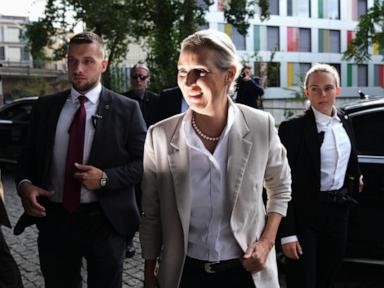
The victory of a far-right party in a German state election has raised alarm across Europe BRUSSELS -- The first victory of the Alternative for Germany in a state election has renewed fears of an ascendant far-right in Europe, as voters repeatedly vent discontent and mainstream leaders grapple with myriad crises, from affordability to Russian aggression and scraps with China and the United States over trade. But while anti-immigrant, pro-Russian parties have made inroads across the continent in recent years, there have also been notable reversals, and some have softened their views to build coalitions with moderates. The AfD fell short of an absolute majority in Sunday’s vote in Saxony-Anhalt that would have allowed it to form the first far-right state government since the Nazi era — though it may still manage to do so.
Far-right leaders from Portugal to Austria celebrated the win as they ready for elections across Europe in the coming months. These will show whether the vote was a watershed moment in the demise of an anti-fascist consensus dating back to the World War II, or the latest in a series of elections worldwide in which frustrated voters simply cast out incumbents. The far-right's biggest success in recent years was the rise of Giorgia Meloni, who became prime minister of Italy, one of Europe's most influential countries, at the helm of a party with neo-fascist roots.
But Meloni, who campaigned as an EU-skeptic, took a moderate turn in office that has won praise from across the continent and led to her presiding over the most stable government in decades. She now faces a challenge from the right, in the form of an upstart party led by a retired general. Far-right parties have meanwhile joined governments and gained key portfolios in Finland, Croatia and Slovakia.
Populist anti-immigrant parties also made major gains in the 2024 elections for the European Union parliament, reflecting their growing support across the 27-nation bloc. Since then, the center-right European People's Party has increasingly coordinated with the far-right, as it did earlier this year in embarking on a historic migration overhaul that incensed traditional allies on the center-left and human rights groups. For 16 years, Hungary's Viktor Orbán was the standard-bearer of the far-right in Europe and an inspiration for populists worldwide.
But he lost in a landslide in April to a former ally who had campaigned against corruption. In the Netherlands, Geert Wilders, another far-right celebrity, broke up a coalition he had helped form when his allies refused to go along with his far-reaching crackdown on immigration. The far-right, anti-immigration Reform UK party has grown in influence in the United Kingdom in recent years and was the big winner in local elections in May, a result that helped spur a panicky Labour Party to replace then-leader Keir Starmer with new Prime Minister Andy Burnham.
Though it holds just eight of the 650 seats in the House of Commons, Reform has often led opinion polls and dominated political debates on immigration. Led by the veteran nationalist politician Nigel Farage, the party has been particularly successful in areas that supported Brexit in 2016. But Reform has recently suffered reverses, losing several special elections and facing questions about funding.
Extract — continue reading at the source.