Here are the leading headlines from and about Germany on Friday, October 30: Ahead of talks with Chinese President Xi Jinping on Friday, German President Frank-Walter Steinmeier lauded China's role as a global technological and economic power, while emphasizing the responsibility that comes along with it. "We both bear responsibility for the international order and for the conditions under which states in this world maintain and shape their relations," Steinmeier said. President Xi praised what he called an "all-dimensional strategic partnership" between China and Germany, calling for new cooperation based on stability and mutual benefit.
"This new paradigm sends a positive signal to the world: we favour openness over closure, and cooperation over confrontation," Xi said during opening remarks, emphasizing the start of a "new chapter" in Germany-China ties. On October 30, 1961, West Germany and Turkey signed an agreement allowing the temporary recruitment of workers. Sixty-five years on, many so-called "guest workers" cannot live from their pensions.
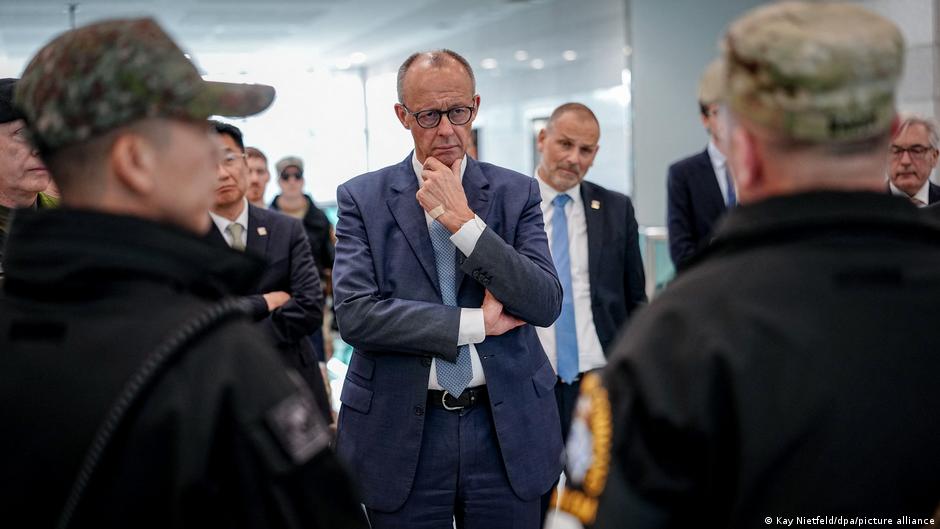
Learn more about how "guest workers" are struggling as they reach retirement age in this in depth report by Oliver Pieper. German Chancellor Friedrich Merz on Friday visited the Panmunjom truce village at the demilitarized zone (DMZ) separating North and South Korea, briefly standing on the North Korean side inside the barracks. North and South Korea have been divided since the end of hostilities in the Korean War in 1953, with a border running across the peninsula.
In remarks to reporters, Merz recalled Germany's reunification 36 years ago. "Let us hope that Korea too gets the chance one day to regain state unity," he said. "You can also notice it here at this place, how much a country suffers from division and how strong the desire is for reunification, at least in this part of the Korean Peninsula," he said, adding that he had been asked about Germany's reunification experience while visiting Seoul.
North Korea, however, has backed away in recent years from diplomacy with the South, having officially removed language calling for reunification from its constitution while changing the South's status to that of a "hostile state." While German Chancellor Friedrich Merz in South Korea on Friday called for a better rule-based trade order, President Frank-Walter Steinmeier was in the Chinese capital in a bid to smooth out trade disagreements. In Beijing, Steinmeier called for preserving the "win-win principle" characterizing Sino-German relations, borrowing from the expression "win-win cooperation," one of the most frequently used phrases in Chinese foreign policy statements. Germany's economic ties with China have gone through a shock in recent years, with Chinese manufacturing growing into sectors once dominated by German firms, and Chinese electric cars taking over market share.
At the start of a meeting with Chinese Premier Li Qiang, Steinmeier cited a recent deal limiting exports of Chinese hybrid cars to the EU in exchange for select tariff cuts on EU exports to China as an example of a "a way to find solutions." Steinmeier also brought up Germany's growing trade deficit with China, which grew to nearly €90 billion ($100 billion) last year. Germany has long resisted tougher action against China, fearing retaliation. But rising pressure on key industries has pushed Berlin to seek stronger EU trade-defense powers to protect its industrial base.
Extract — continue reading at the source.