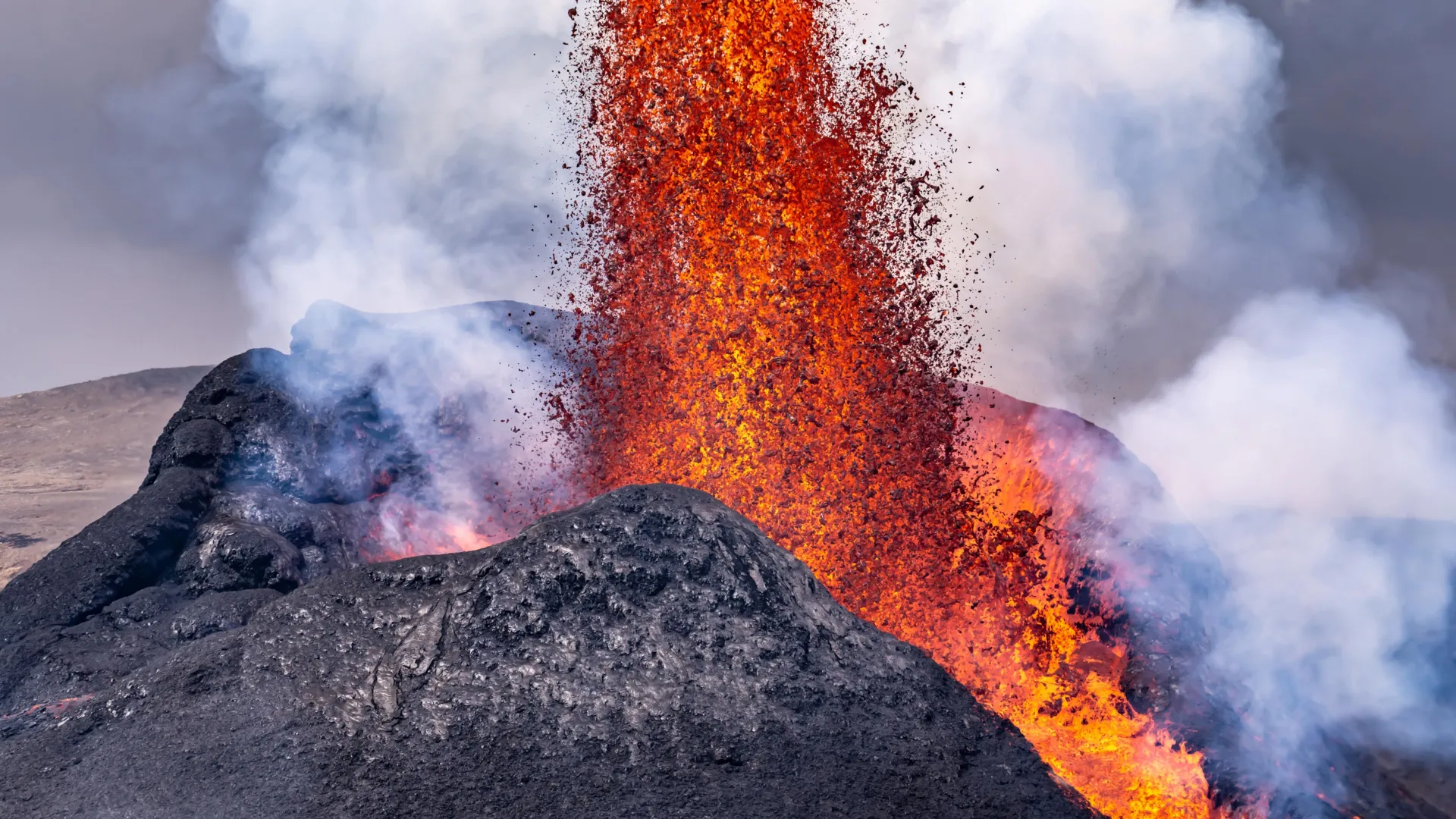
This article has been reviewed according to Science X's editorial process and policies. Editors have highlighted the following attributes while ensuring the content's credibility: A vast sheet of volcanic rock in the Andes has preserved clues to a buried landscape that existed 22 million years ago, according to a new study led by UCL (University College London) researchers. The study, published in Science Advances, shows that a giant volcanic eruption acted a little like Vesuvius, but across an entire landscape, burying the terrain beneath it and preserving information that would otherwise have been lost to erosion and deformation.
For the study, the researchers looked at the vast expanse of volcanic rock that erupted from the Lauca Caldera in northern Chile 21.9 million years ago. A caldera is a large volcanic depression formed during major eruptions. A mountain's worth of rock, called ignimbrite, covered an area six times as large as Chile's capital, Santiago (or nearly three times as large as Greater London), reaching 1 kilometer (0.6 miles) deep in places.
The research team simulated hundreds of possible ancient landscapes, using models of how rivers shape mountain ranges, to test which ones could plausibly have been buried beneath the volcanic deposit. They found that only relatively low-relief landscapes—akin to gentle mountain foothills—could have done so. From this, the team inferred that this part of the Andes was being built slowly, with rocks pushed upward by no more than 0.26 kilometer every million years—equivalent to 2.5 cm, or about an inch, every 100 years.
If rocks had been pushed upward faster in this region, the landscape would probably have developed steeper slopes that could not have fit beneath the immense volcanic deposits. The finding lends support to the idea that the Andes grew slowly and steadily over tens of millions of years rather than popping up more recently, in the last few million years. This rate is slow compared with many rapidly uplifting parts of active mountain belts, including parts of the Himalayas, where uplift and erosion can occur at rates of several millimeters to centimeters per year.
Byron Adams, based at UCL Earth Sciences, said, "This landscape was buried by a giant volcanic eruption—a little like Pompeii, but on a vastly larger scale. Instead of covering a town, hot mixtures of volcanic ash, rock fragments and gas swept across an entire landscape, engulfing the terrain beneath them. "Pompeii shows how volcanic eruptions can freeze a moment in human history.
This study shows that much larger eruptions can also freeze moments in Earth history, burying whole landscapes beneath volcanic deposits and preserving clues to how mountains were being built before the eruption. "We cannot dig down to see the buried landscape, but we can use the shape of the volcanic blanket and what we know about how rivers shape mountains to infer what is hidden beneath it." The paper's authors noted their estimate of rock uplift was consistent with earlier research looking at minerals in the rock that recorded specific changes in temperature over the last 50 million years. These temperature changes represent the rock cooling as it travels upward through Earth's crust.
Extract — continue reading at the source.