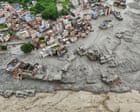
A glacial collapse triggered the catastrophic flash flood in Nepal and Tibet that roared down valleys, wiping out entire villages and leaving a preliminary death toll of at least 165 people, the US Geological Survey said. Rescuers on Thursday raced to locate the hundreds missing, including nationals from India, the US, UK, Australia and Canada. Terrifying videos from the event on Wednesday showed a massive wall of water crashing down on the border as people attempted to flee.
Trucks were upended and houses, roads and power projects swept away in Nepal, while officials in Tibet said they feared “major casualties” after a mudslide hit a border land crossing. In the affected areas, houses, trees and vehicles were submerged or buried in mudslides. Helicopters hovered overhead all day in the area bringing in survivors.
Nepal’s tourism ministry said 468 tourists and travellers, including 393 foreign nationals, were unaccounted for in the mountainous region popular with trekkers and pilgrims. Chinese state media said at least 558 were missing on the Tibet side of the border, of whom at least 260 were foreign nationals. The missing foreigners included 142 Indian nationals, 47 people from the US, 34 from Australia, 33 from Britain and 24 from Canada, according to the Nepal tourism board.
Police in Nepal said 165 bodies had been recovered by late Wednesday. Chinese state media reported three dead on the Tibet side of the border. Many of the victims were on a pilgrimage to Kailash Mansarovar, a high-altitude site in Tibet that is revered by Hindus and Buddhists among others.
Early reports from Nepali officials initially suggested an earthquake in the area could have caused the lower part of a glacier to collapse and trigger the floods. But the US Geological Survey later said what was initially reported as a 4.4 magnitude earthquake was a seismic shock generated by glacial rock and ice collapsing and the flow of debris. Experts say the risk of such events is compounded by the extreme topography of the Himalayas.
In the wake of the disaster some shared harrowing stories of how they managed to survive. Then a wall of water came thundering down as if it was an earthquake,” said Bibek Kumal, a labourer who was working downstream from the worst-hit Rasuwa district, near Nepal’s Himalayan border with China’s Tibet. From his hospital bed, Kumal said the torrent swept him downstream amid mud and debris but he survived by clinging to a mango tree.
Extract — continue reading at the source.