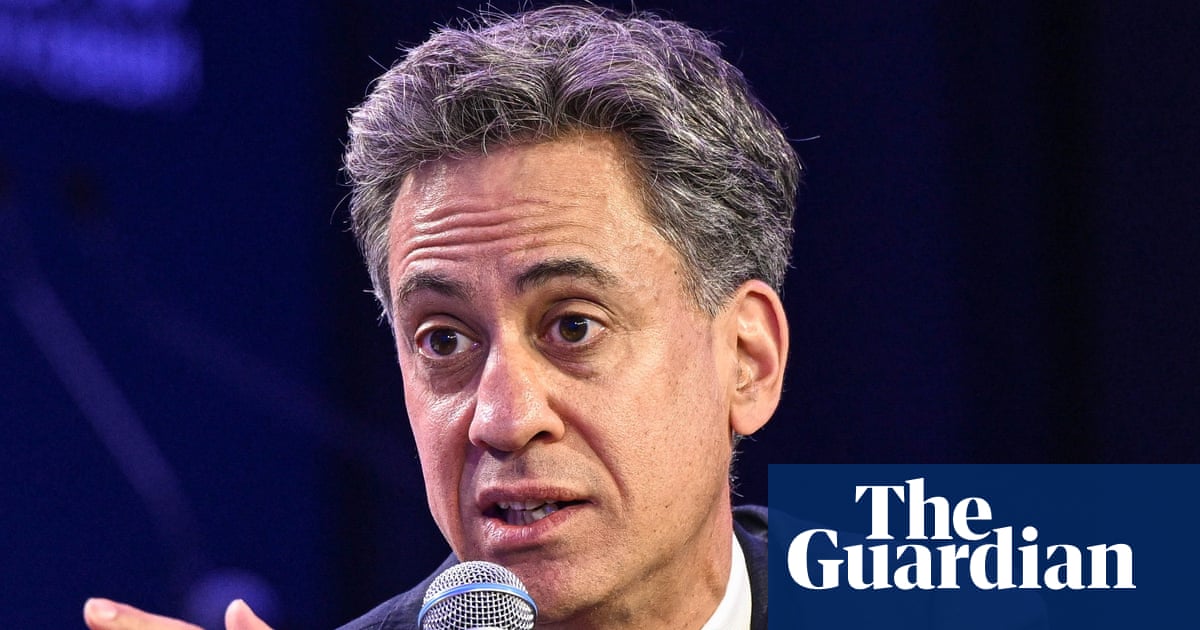
The foreign secretary, Ed Miliband, will claim the global financial system is failing developing countries, as he calls for a “new deal” for governments struggling under the burden of debt. Promising to throw the UK’s diplomatic weight behind urgent reform, he will evoke the example of the Gleneagles summit under the last Labour government in 2005 – the culmination of the Make Poverty History campaign. This is not just against our values but against our national interest,” Miliband is expected to say.
He opted to take up the UK’s seat on the bank’s board himself instead of leaving it to the development minister, Kirsty McNeill. Labour’s manifesto in 2024 promised to restore the UK’s international reputation on development issues – but Keir Starmer subsequently slashed the aid budget to pay for defence. Campaigners have long claimed the high interest rates paid by many developing countries mean the repayments crowd out vital public spending – including on tackling the climate emergency.
In sub-Saharan Africa, more than three times as much is spent on debt servicing as on education. Miliband will argue that making the global financial system work better for emerging economies will also help to attract more private investment – a key aim of the World Bank under the current president, Ajay Banga. The UK is due to take up the presidency of the G20 group of nations next year – a key global forum for discussing global financial issues, including sovereign debt, which includes emerging economies such as China, India, South Africa and Brazil.
The chancellor, John Healey, will set out his own G20 priorities in Bangkok later this week, including mobilising more resources from the balance sheets of the IMF and the World Bank. When the UK held the chair of the narrower G8 group in 2005, at the leaders’ summit at the Gleneagles hotel the UK secured agreements that eventually resulted in more than 30 countries receiving large-scale debt write-downs. Miliband will say resources are now more constrained – but as well as debt refinancing for a large number of countries, he will demand an overhaul of the “common framework” for restructuring the debts of countries unable to pay.
The framework is widely criticised as too slow and cumbersome. Among other reforms, the UK wants to see changes to ensure private creditors cannot hold up negotiations – as has happened in recent cases including that of Ethiopia. The foreign secretary will also call for overhauls to allow help to be made available more rapidly to countries in trouble.
Miliband will be speaking at the launch of a report by the Rockefeller Foundation thinktank, which calls for a “surge” in affordable financing from the IMF and the World Bank to debt-burdened countries. Tim Jones, the policy director of the campaign group Debt Justice, welcomed Miliband’s focus on the issue but said a litmus test of any plan would be whether private sector creditors bear some of the costs. That must include private lenders sharing in the cost.
Extract — continue reading at the source.