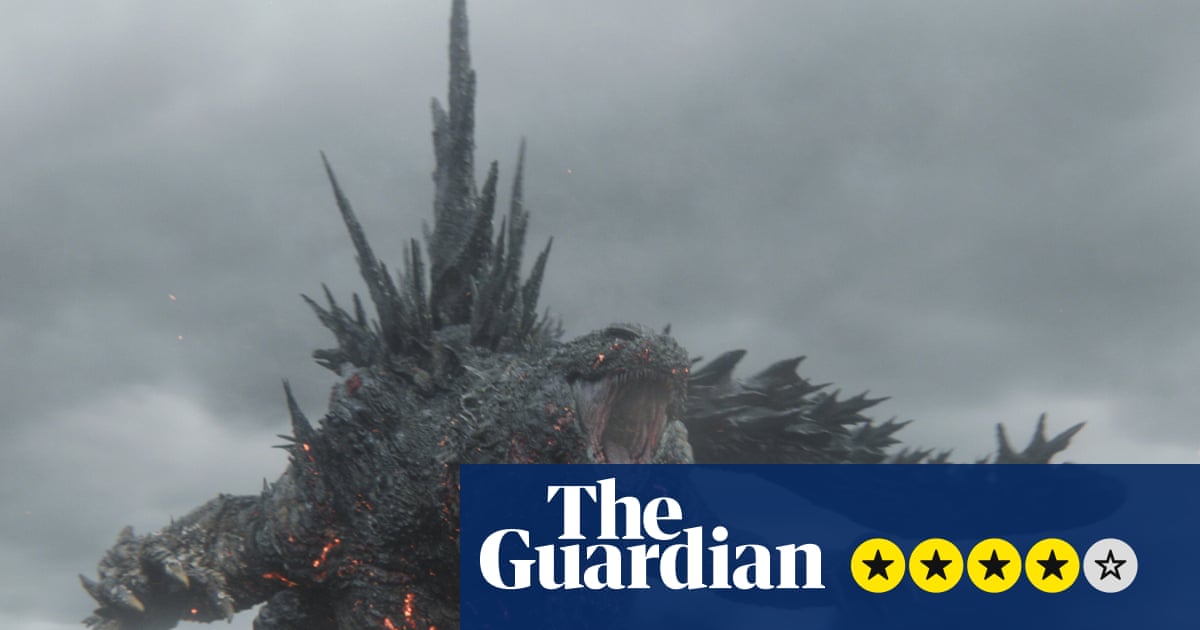
Even by the standards of older movie stars catching a major second wind later in their careers, Godzilla pulled off an impressive reclamation of the spotlight three years ago. Godzilla Minus One, the most recent reboot featuring the 70-year-old kaiju – the version(s) from his native Japan, mind, not the Americanized one concurrently starring in a series of Warner Bros blockbusters opposite King Kong – wasn’t just another monster-movie success. It fully crossed over, becoming the highest-grossing Japanese-language movie ever released in North America, and won an Academy Award to boot for its terrific visual effects.
Japanese Godzilla characters are mainstream enough to pop up in Happy Meals, and the Toho-made sequel Godzilla Minus Zero is world-premiering at the New York film festival. Arguably the artsiest, brainiest of the major fall fests is playing unexpected host to a truly spectacular monster battle royale, packaged alongside some of the same thoughtful historical context that informed the previous film. Writer, director and VFX maestro Takashi Yamazaki returns for the sequel, bringing his lead characters back with him.
In the previous film, former military pilot Kōichi Shikishima (Ryunosuke Kamiki) used his experience with Godzilla to overcome his guilt and shame over failing to complete a pointless kamikaze mission toward the end of the second world war – the devastation of which brought Japan back to “zero”, hence a newly emergent Godzilla bringing the country to “minus one”. Minus Zero catches up with Kōichi, his now-wife Noriko (Minami Hamabe), and their adopted daughter Akiko (Sae Nagatani) two years later, in 1949 (although Akiko somehow seems more or less the same age). Another monster threat looms over post-war Japan in the form of a dragon-like creature dubbed Ghidorah, whose menace will be familiar to kaiju fans. (Though he isn’t seen directly in trailers, this isn’t a spoiler; he’s featured from the very first scene of the film.) Ghidorah’s appearance obviously sends off alarms in the disaster-response agency that now employs Kenji Noda (Hidetaka Yoshioka), also from the previous film.
Noda is joined by Makoto Aoyama (Masami Nagasawa), a meteorologist who introduces less artillery-heavy defense mechanisms for this new threat. Of course, there is a natural Ghidorah deterrent last seen disintegrating into the sea but known for his adaptability – if only the big guy could be called upon and steered in the right direction. In the older Godzilla films, Ghidorah-Godzilla battles can sometimes make whatever humans who might fit into the picture seem all the more insignificant; the monsters are so fearsome and, in their way, charismatic, that they level anything else in their way.
In the tradition of its emotionally involving predecessor, Godzilla Minus Zero grapples more directly with humans’ attempts to assert some control over forces that initially seem impossible to harness. It’s no accident that one of its new heroes attempts to predict the weather – and has faced natural disasters despite her accurate predictions. The characters wield technology that is more science-fictionally advanced than in the previous movie while still relying on a sense of impromptu can-do scrappiness and determination to protect their country.
With decreased puny-human helplessness comes greater dangers and new dilemmas. The film’s version of the US military, for example, is willing to provide planes but not troops to aid in the fight, which is partially how Kōichi and Noriko are drawn back into the conflict despite the pleading of young Akiko. The partners’ skill sets make them valuable assets, perpetuating some of the previous film’s questions about what kinds of sacrifices might be expected or required when sending citizens into the thick of battle.
Extract — continue reading at the source.


