This article has been reviewed according to Science X's editorial process and policies. Editors have highlighted the following attributes while ensuring the content's credibility: What are the chances of finding extraterrestrial life in our solar system? Frank Postberg, a professor of planetary science at Freie Universität Berlin, has published a study in Science Advances with an international team of researchers.
They present new evidence that it is easier to determine the constituents of the ocean hidden beneath Enceladus's icy surface than previously assumed. Postberg also contributed to a second study published the same day. In that study, he and another planetary scientist from Freie Universität, Dr.
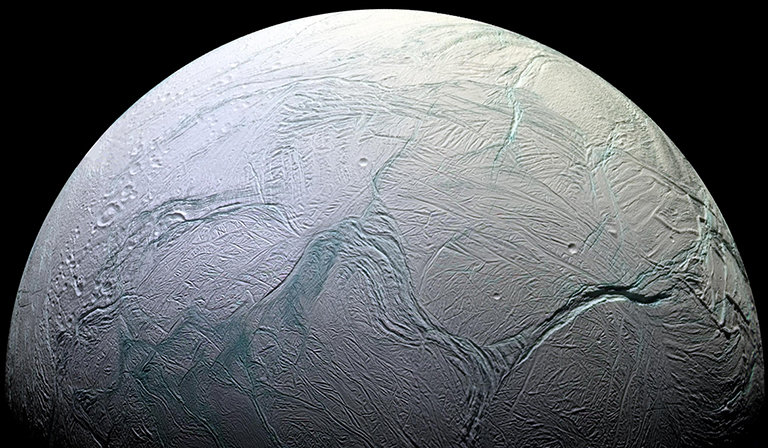
Nozair Khawaja, helped show that certain microorganisms could tolerate the conditions in Enceladus's ocean better than previously thought. The results increase the likelihood of finding evidence of life on Saturn's moon. Enceladus is considered one of the most promising places to search for extraterrestrial life in our solar system.
Researchers suspect that a global ocean of liquid water lies beneath the moon's icy crust, with a rocky core farther below. Due to cryovolcanic activity, gigantic plumes break through cracks in the crust at the moon's south pole, ejecting ice particles hundreds of kilometers into space. NASA's Cassini spacecraft passed through these plumes multiple times to analyze their composition.
Enceladus's ocean is the only extraterrestrial "body of water" from which scientists have been able to directly analyze samples. The samples revealed traces of various salts and organic compounds. Previous analyses by Cassini also indicated hydrothermal processes on the seafloor and other conditions that could support life.
Postberg's study, "Cassini CDA Observes Compositional Segregation of Enceladus' Ice Grains from Slow Freezing and Fragmentation of Oceanic Spray," includes surprising findings about what happens to the ocean water on its way into space. The international team used Cassini data, long-term laboratory experiments and theoretical models to reconstruct the process. Droplets form at the ocean's surface as gas-filled bubbles rise and pop.
Extract — continue reading at the source.