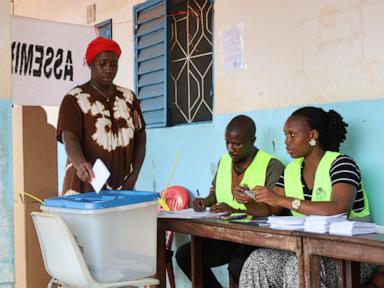
Guinea-Bissau is voting in a referendum to decide on granting new presidential powers BISSAU, Guinea-Bissau -- BISSAU, Guinea-Bissau (AP) — Guinea-Bissau was voting Sunday in a referendum to decide on granting new presidential powers ahead of December's general election, which will return the West African nation to democracy after its latest coup. There was a low turnout across many voting stations after the opposition urged voters to boycott the referendum, saying it would make the head of the military government more powerful. The military government seized power in November of last year following a disputed election in which former President Umaro Sissoco Embaló and opposition candidate Fernando Dias both claimed victory.
If passed, the new constitution by the self-styled National Transitional Council will grant more powers to the president and reduce parliamentary representation, among other issues. The authorities argue that a parliament trimmed from 102 to 65 seats would allow for easier and more robust debates, while new presidential powers would underline the higher authority of the president over the prime minister, which they claim is a source of political instability in the country. Opposition groups reject the claim.
No community or village can have two leaders. We revised the constitution to avoid constant conflict between the president of the republic and the prime minister. We clarified the law and helped the public understand that the president of the republic is the national symbol.
It is the president who stands for election in presidential polls,” Gen. Tomás Djassi, the head of the armed forces, said. But the opposition has called on voters to boycott the referendum, saying it is a path for the head of the military government to amass power and calling it a "source of political instability at all levels".
Last year's coup in Guinea-Bissau worsened West Africa's democratic crisis, adding it to a growing number of countries in the region under military rule. Leaders on the continent branded it a “staged” takeover after the military allowed the former president to host a press conference to announce he was being deposed and allowed to leave the country in seemingly favorable circumstances. Skeptics say Embaló had given up the seat to the military after seeing he was losing the election.
Since it gained independence from Portugal in 1973, the only Portuguese-speaking country in West Africa has been rocked by several coups and attempted coups. Before last year’s coup, a failed coup was reported only a month before. The tiny country of around 2.2 million people has the highest proportion of natural wealth per capita in West Africa, according to the World Bank, but more than half of the country lives in poverty.
Extract — continue reading at the source.