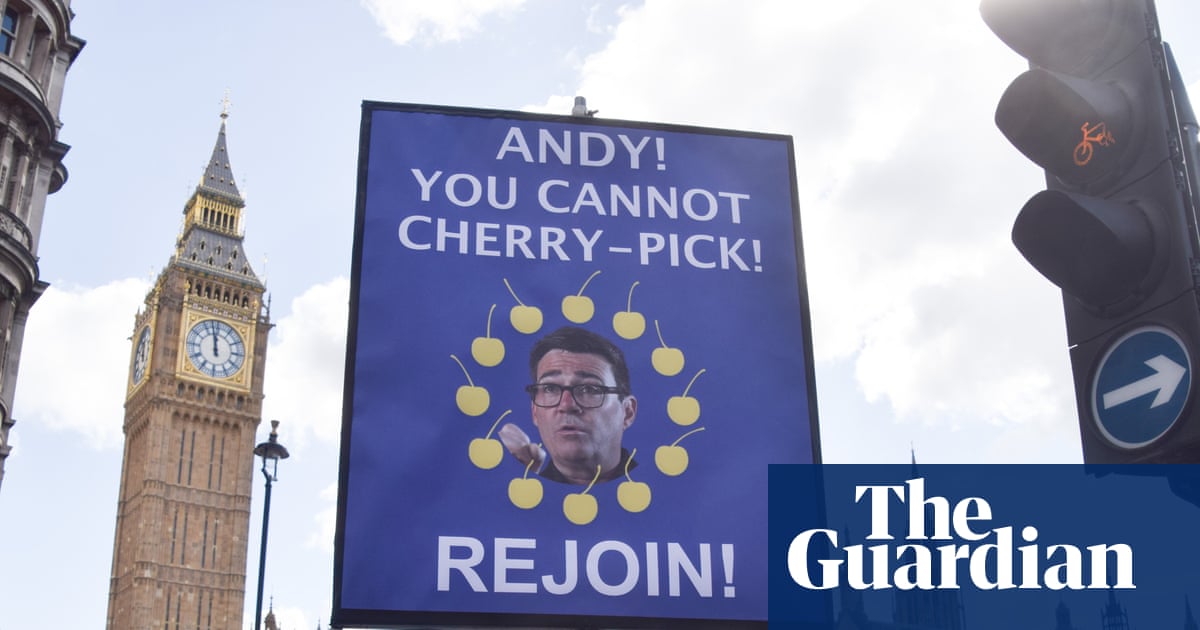
Andy Burnham’s personal preference to rejoin the European Union after the next election is supported by almost half of all voters, a new megapoll has found, although cabinet ministers concerned about reopening Brexit divides are privately urging him to proceed with caution. The poll by the Messina Group (TMG) found that renegotiating the UK’s relationship with the EU could boost Labour’s vote share by as much as seven points, if the prime minister offered a fresh referendum in which he campaigned to re-enter the bloc. Almost a third of voters said an in-out referendum would be needed first, while more than one in six felt that a general election mandate would be sufficient, and the same proportion thought parliament could make the decision.
The overall findings will bolster the case of those inside Downing Street who want to promise at the next election that Labour would at least negotiate over re-entry, which the prime minister has said he wants to see “in his lifetime”. Burnham used his first Labour conference speech as leader on Tuesday to announce a review of the options for Britain’s future relationship with Europe, and subsequently added that these should include rejoining entirely. However, there are nerves among some Labour MPs, especially those with constituencies that voted for Brexit, that even testing out public support for the move would be fraught with political risk and a potential boost to Reform.
Two-thirds of cabinet ministers, including Burnham himself, his first secretary, Louise Haigh, chancellor, John Healey, and foreign secretary, Ed Miliband, represent seats that backed Brexit, and previously said they would respect the 2016 vote. However, public opinion has shifted. Before Burnham’s speech, several ministers had publicly cautioned against the move.
Lucy Powell, Labour’s deputy leader, said while the defence and security relationship could be better, going beyond EU reset plans inherited from Keir Starmer was “not possible nor desirable”. The trade secretary, Jonathan Reynolds, said “constitutional questions” around Britain’s EU relationship were causing uncertainty for business. The home secretary, Shabana Mahmood, said rejoining was “not a simple, straightforward thing” and the costs might be unacceptable.
Downing Street’s strategy appears to be to put the focus on those who made big promises on Brexit but then failed to deliver, rather than accusing those who voted to leave the EU of making the wrong decision. But the government’s shift in position has caused some anxiety among Burnham’s team. One cabinet minister told the Guardian: “Brexit clearly hasn’t worked and the promises made haven’t been kept so Andy is right to open up the question of what the future relationship looks like.
But he definitely needs to proceed with caution because we don’t want to restoke division”. A second said: “Andy is right to say we need some clarity around our long-term relationship. Security and trade cooperation are higher up the agenda than they were 10 years ago.
Extract — continue reading at the source.