This article has been reviewed according to Science X's editorial process and policies. Editors have highlighted the following attributes while ensuring the content's credibility: As ocean temperatures rise, corals' ability to withstand and adapt to heat stress is critical for the future of coral reefs. Many reef-building corals already live near their upper thermal limits, making them vulnerable to bleaching and, with prolonged stress, mortality.
But corals don't all respond to heat the same way. Thermal tolerance can vary among species, populations and individual colonies and may be shaped by genetics and the environments in which they live. Understanding these differences could help to predict which corals are more resilient as oceans warm.
Hawaiʻi offers a unique setting to study this question. Nearby reefs in Kāneʻohe Bay and Kailua Bay experience markedly different conditions, with Kāneʻohe warmer and more sheltered and Kailua cooler and more exposed. This contrast enables researchers to examine whether a coral's environmental history influences its ability to withstand heat stress.
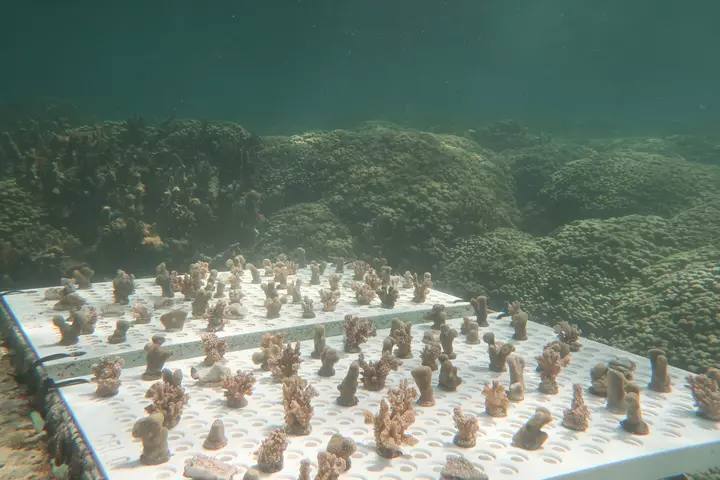
A Florida Atlantic University Harbor Branch Oceanographic Institute study, in collaboration with the University of Hawaiʻi, compared the thermal tolerance of two abundant reef-building corals: Montipora capitata, or rice coral, which can form broad plates or branching colonies with a textured surface; and Porites compressa, or finger coral, which grows in clusters of slender, finger-like branches. Coral fragments from both species were collected in Kāneʻohe Bay and Kailua Bay and exposed to controlled thermal stress in the laboratory. Researchers used pulse amplitude modulation fluorometry to measure photosynthetic efficiency as an indicator of physiological response to warming.
They then compared corals from the two environments to determine whether thermal tolerance varies by origin and whether the pattern is consistent across species. Results of the study, published in Scientific Reports, reveal that the ability of corals to withstand heat stress can vary not only by species but also by where they live. Both species showed substantial thermal tolerance, with bleaching thresholds above the 4-degree heating week level that NOAA uses as an indicator of accumulated heat stress associated with the onset of significant coral bleaching.
However, one species stood out: P. compressa from the cooler, more exposed waters of Ulupaʻu had significantly higher thermal tolerance than P. compressa from warmer, more sheltered Kāneʻohe Bay and than M. capitata from either location. For M. capitata, thermal tolerance was remarkably similar between the two bays. At Ulupaʻu, however, P. compressa tolerated significantly more accumulated heat stress than M. capitata.
Extract — continue reading at the source.


