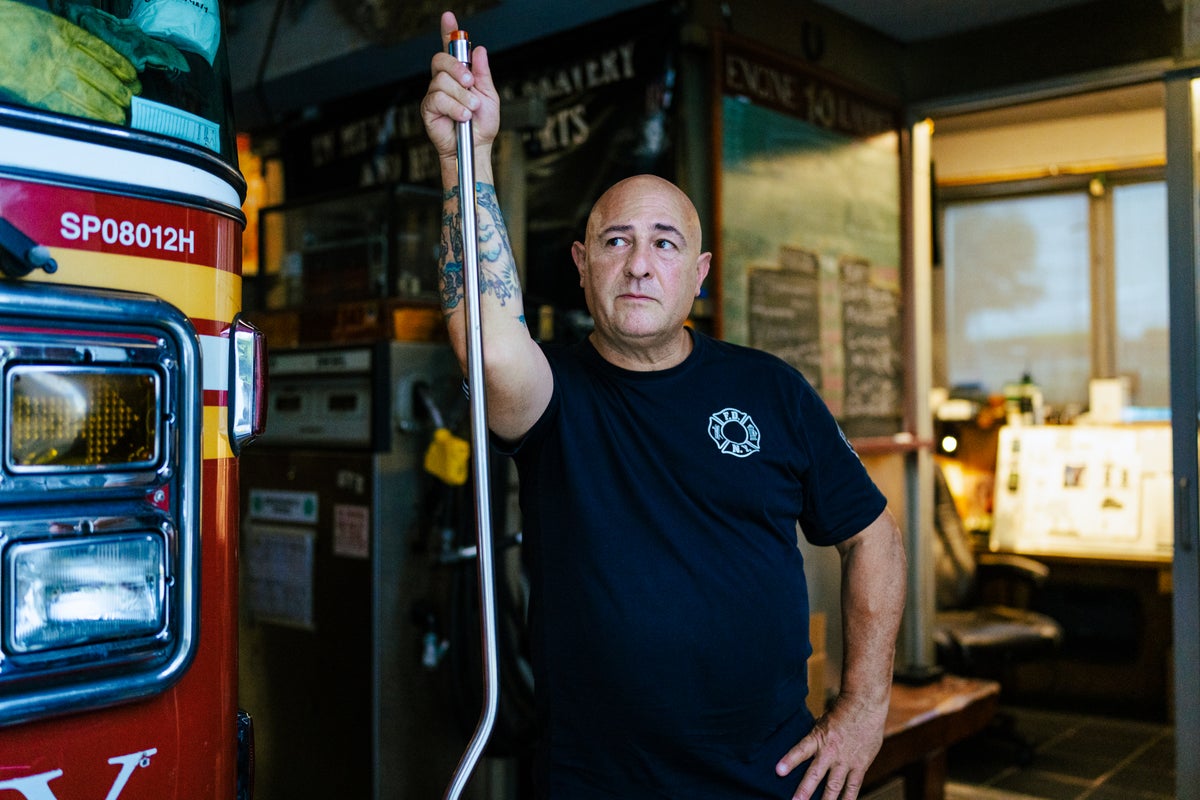
On September 11, 2001, New York City firefighter Sal Argano benefited from a stroke of luck. Rather than working at his regular station—a small Manhattan firehouse situated directly across an intersection from the Twin Towers—he was on temporary loan to another unit in Brooklyn when hijacked planes struck the World Trade Center. Racing downtown, he discovered his firehouse badly damaged but still standing.
He would later learn that six of his colleagues were among the 343 New York City firefighters killed in the collapse of the World Trade Center. "If I wasn’t sent out on rotation there would have been a good chance I would not be here today," Argano says. "I think about that all the time." Nearly 25 years later, Argano, now 65, remains on active duty at the firehouse—the final firefighter assigned there in 2001 who still works at the station.
Today, while the crews respond to emergency calls, the station also serves as an informal part of the 9/11 memorial, drawing crowds of tourists every day. Some visitors stop specifically to view the large bronze relief along the side of the building, which lists the names of the firefighters killed on 9/11. Others pause for selfies on their way to the National 9/11 Memorial plaza across the street, drawn by the sight of Engine 10 and Ladder 10, the gleaming trucks inside the garage that give the station its nickname: Ten House.
"This is definitely one of those companies where if you don’t want to ingratiate yourself to the public, it’s definitely not the right place," said Capt. Terence Brody, who commands Ladder 10 and has worked at the station since 2016. "People around the world know this firehouse.
They’re going to come by and say hello." Brody, now 55, was still in the fire academy on 9/11. Cadets grabbed their gear and were bused directly to ground zero. The debris hung so densely in the air around the fallen towers that it appeared to be snowing, he recalled.
"It was a beautiful sunny Tuesday, and then you’re in this kind of apocalyptic atmosphere," Brody said. "It was a little overwhelming, to say the least." In the days following the attack, Ten House served as both a command center and a safe haven for exhausted first responders, he said. As the years passed, its crew watched the neighborhood's rebirth from the front row.
Extract — continue reading at the source.