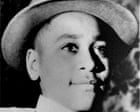
Seventy-one years after the brutal murder of Emmett Till, the way that the US as a country honors his memory is still being contested. Markers commemorating his life have been shot at, stolen and become the site of white supremacist group recruiting events. A new exhibit opening in Chicago asks the country to memorialize his life not only by remembering his death, but by asking America to consider the question: What if Emmett Till Lived?
Open now and running until December, the exhibition If Emmett Till Lived: Freedom on American Ground at the Museum of Contemporary Photography in Chicago is an imagined photo library depicting the life Till never got to live. Through the images on display, co-curators of the show, Sarah Elizabeth Lewis, a Harvard professor and founder of the Vision & Justice initiative, and Reverend Wheeler Parker Jr, Emmett Till’s cousin, best friend and last surviving witness to his kidnapping, ask the nation to consider who gets to be remembered on American soil and how the country chooses to see its history. So, you think about what it would have been like.
Then I look at the other side, at the laws that were passed and the things that were created because of his death. You’re appreciative and you thank God for that, but he’s still not here. So you have a lot of mixed emotions about him and death.” In the months leading up to the exhibit’s opening, the state of Illinois officially designated 25 July, Till’s birthday, as Emmett Till Day.
Last month, the barn where Emmett Till was murdered was bought by Patrick Weems’s Emmett Till Interpretive Center, with plans to make the space a site of remembrance. And this week, the church where Emmett Till’s funeral was held unveiled a re-creation of the historic neon sign in honor of Till, signaling the exhibition’s opening. When you see the resistance to honoring Emmett Till’s life 70 years later, you start to realize that there’s more to be done.
I realized that I not only needed to do my part, but needed to extend the space of the exhibition to constitute a new arena for reimagining society, and that’s what birthed this exhibition.” In the summer of 1955, Emmett Till, a 14-year-old Black boy from Chicago, was visiting relatives in Mississippi with his cousin, Reverend Parker. While standing outside Bryant’s Grocery & Meat Market, he whistled at a shopkeeper, a white woman. Four days later, the woman’s husband and half-brother kidnapped him and took him to a barn where they tortured, mutilated and killed him.
At trial, the woman’s relatives were acquitted but later confessed to the murder in Look magazine. Lewis argues that it is important to remember Till despite efforts to erase his name from American memory. On 4 September 1955, she held an open casket funeral at Roberts Temple Church of God in Christ on the South Side of Chicago, Illinois, for nearly 100,000 attenders.
Extract — continue reading at the source.