Defense Secretary Pete Hegseth has invited governors and state military officials across the country to make their case for hosting a brand-new U.S. military installation—the first such major new base to be built in decades. During his September 30 "State of the Force" address at Marine Corps Base Quantico in Virginia, Hegseth called on every governor and adjutant general to make the case for why their state should host what he called the "Next Great American Base." "If your state wants the honor of hosting 15,000 to 25,000 of America's great troops, show us why and how you're going to do it—cutting through the red tape, offering up the land and rolling out the red carpet for our military families," Hegseth said. He described it as a "dynamic, self-sustaining power projection platform" with its own power generation, modern air defenses and advanced technology.
But exactly where such an installation could go remains unclear. Katherine Kuzminski, director of studies at the Center for a New American Security, told Newsweek that one of the biggest questions is what Hegseth means by a “base.” The U.S. military has service-specific installations as well as Joint bases, where multiple branches operate together. If the Pentagon intends to create a genuinely joint installation involving the Army, Navy, Air Force, Marine Corps and Space Force, the list of potential locations becomes considerably narrower.
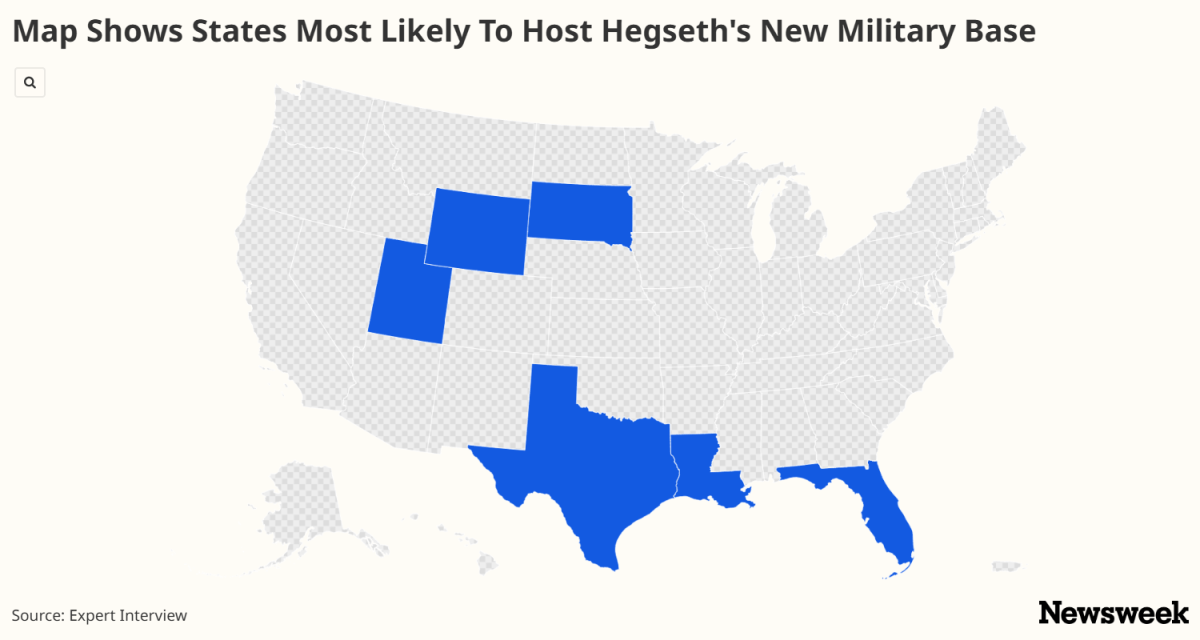
Kuzminski said she also believes the Pentagon will be "looking for a community with a proven track record of support for military service, which may be a factor considered." One factor that Kuzminski said she hopes does not play a role, but fears it could, is the state's politics. "The decision should not in any way be based on partisan political leanings, though that may ultimately be a factor that is considered," she said. Based on those criteria, Kuzminski said six states stand out as locations that could fit different versions of Hegseth's proposal: Texas, Louisiana, Florida, South Dakota, Wyoming and Utah.
Texas can offer a strong argument to host the new military facility due to its "strong military footprint" and Gulf Coast access, according to Kuzminski. She specifically highlighted Corpus Christi or an area between Corpus Christi and Houston as a possible location. She ruled out the city of Houston itself.
"Houston would provide access to the Gulf, but has too large of a population that would be displaced," she said. Kuzminski said a new installation would need "a lot of available land" and should not be in an area with a large local population, given the displacement and other effects an installation of this size could create. Texas already has the kind of military infrastructure that could support such an expansion.
The state has 15 active-duty military installations, including Naval Air Station Corpus Christi, Naval Air Station Kingsville, Corpus Christi Army Depot and Joint Base San Antonio. Corpus Christi is particularly notable because it already combines multiple military missions. Naval Air Station Corpus Christi is home to the Navy’s Chief of Naval Air Training and a Navy flight-training wing, while the adjacent Corpus Christi Army Depot is the Army’s largest helicopter repair, overhaul and maintenance center.
Extract — continue reading at the source.