Since soaring on screen 20 years ago, this Disney Channel favourite has cemented itself as a squeaky clean, painstakingly earnest but no less beloved descendant of Grease. Like Danny and Sandy, Troy Bolton and Gabriella Montez share a holiday romance and wind up at school together the following term, where the social pecking order initially keeps them apart. Driven by a shared love of singing, they defy conventions to end up together.
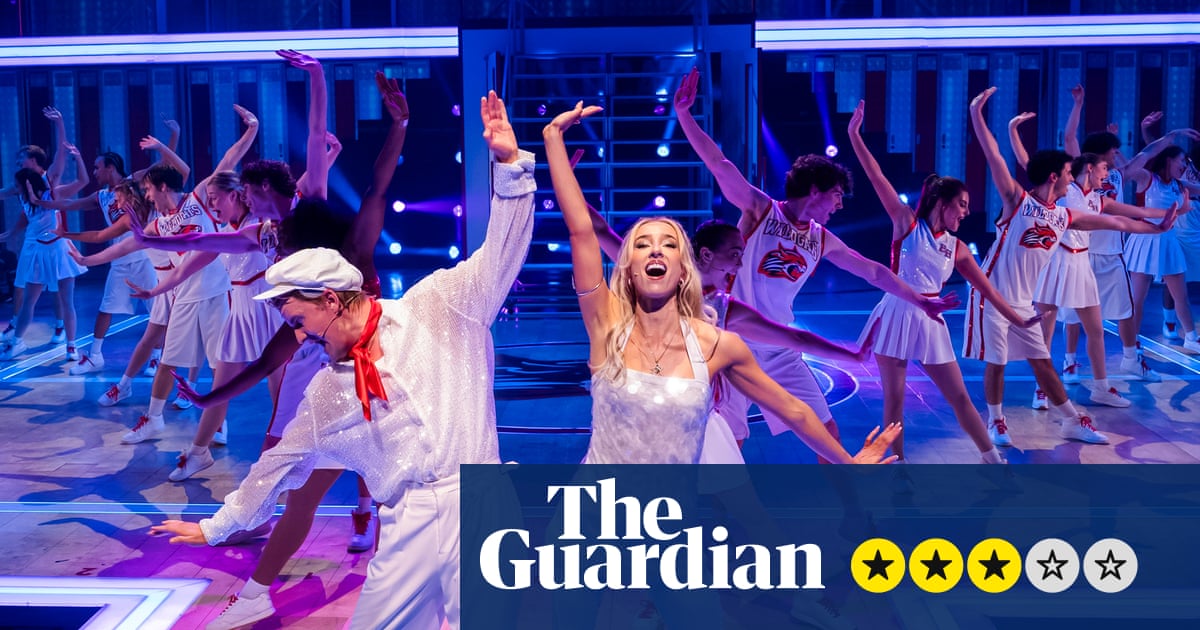
This new stage production, first seen at Salford’s Lowry, is directed by Hope Mill theatre founders Joseph Houston and William Whelton. No, it can’t escape the limitations of the story’s spectacularly two-dimensional characters, who are siloed into the camps of jock, brainiac or drama kid, and whose stock traits are indulged in the book by David Simpatico, but it’s bright and buzzy nonetheless. The thrust stage of Andrew Exeter’s basketball-themed set positions us courtside, while Rory Beaton’s bright lights, Matt Peploe’s thunderous sound design and George Reeve’s videography – beamed on to screens surrounding the gym – help animate the spectacle playing out on court, where the school’s Wildcats team are shooting hoops and pompom-waving cheerleaders are drumming up hype.
It’s dizzying and dazzling – never more so than during the revival of Bop to the Top, led by Luke Bayer and Caitlin Tipping as siblings Ryan and Sharpay Evans, who are every bit as entertainingly grating as their screen counterparts. Aaron Renfree’s nimble choreography rotates montages from the all-important science competition, basketball game and musical callbacks, as Troy and Gabriella race against the clock to make it to auditions. The headline names belong to the teachers: KayCee Stroh, who played hip-hop-loving Martha Cox in the films, is now over-the-top drama teacher Ms Darbus, while McFly’s Harry Judd plays austere Coach Bolton with brow-furrowed concentration.
As Troy and Gabriella, Tobias Turley and relative newcomer Leonor Correia bring a sweetness, but their chemistry is yet to fully bloom. Gabriella’s When There Was Me and You is, here, a duet sung by the pair of them in an arrangement that cops out of the high notes, but throbs with teenage longing. Breaking Free really does see them soar, albeit on a stiff-looking swing.
Still, if it skirts the ring more than it nets the ball, I suspect adoring fans won’t leave disappointed.
Extract — continue reading at the source.