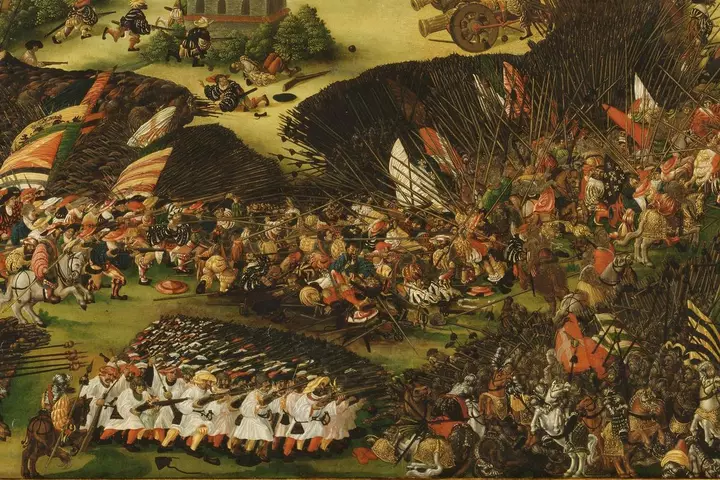
Detail from The Battle of Pavia, 1525 (c1529) by Robert Heller. Courtesy the Nationalmuseum, Sweden/Wikipedia If you were asked to think of a gun owner, then Lorenzo de’ Medici – the celebrated patron of Renaissance art – would probably not be the first person to come to mind. In fact, however, Lorenzo ‘the Magnificent’ owned five portable firearms, which are listed in his 1492 postmortem inventory.
Guns and gunpowder were controversial. In art and literature, they were labelled the Devil’s work, and were perceived as fundamentally unchivalrous. Yet within half a century, by the early months of 1539, Lorenzo’s descendant Duke Cosimo de’ Medici had 91 firearms in his Florentine storerooms.
Somehow, in the courts of late-Renaissance Italy, the gun had become an acceptable, even valued, weapon. Beyond the palazzi of the peninsula’s towns and cities, guns were also making inroads into more ordinary lives. There were no standing armies in the 16th-century Italian states.
Their wars were fought through temporary mobilisations, and with considerable help from companies of mercenaries. Yet as the 1506 provision that established the Florentine militia made clear, ‘little hope’ could be placed ‘in foreign and hired arms’. Far better to establish a new magistracy with ‘full authority and power’ to enlist men from Florentine territory, at least 10,000 of them.
One in 10 of these men were to be equipped with firearms, and 500 handguns (schioppetti) should be kept in the Palazzo della Signoria (the city hall, now known as the Palazzo Vecchio) along with ‘such money as should be necessary for the schioppetti’, presumably to purchase gunpowder and shot. Three or four companies (bandiere) entirely of schioppettieri might also be established. This militia, most often noted for the role of Niccolò Machiavelli in its foundation, was to be organised after the fashion of the Germans, in whose cities there was a centuries-old tradition of civic defence and a duty on every male citizen to maintain suitable arms for the purpose.
In fact, one of the Florentine militia’s early constables was German (a Giovanni Tedesco); another (Giliberto Spagnolo) came from Spain, a country making the running in the use of small arms on the battlefield. Giovanni Tedesco arranged target practice for his company, which from 1508 was extended more generally among the militia, with exercises taking place on a monthly basis. Militias were not new but, by the 1490s, large-scale foreign military intervention on the Italian peninsula was giving a new impetus to their development, as was the growing importance of infantry in the military context.
Extract — continue reading at the source.