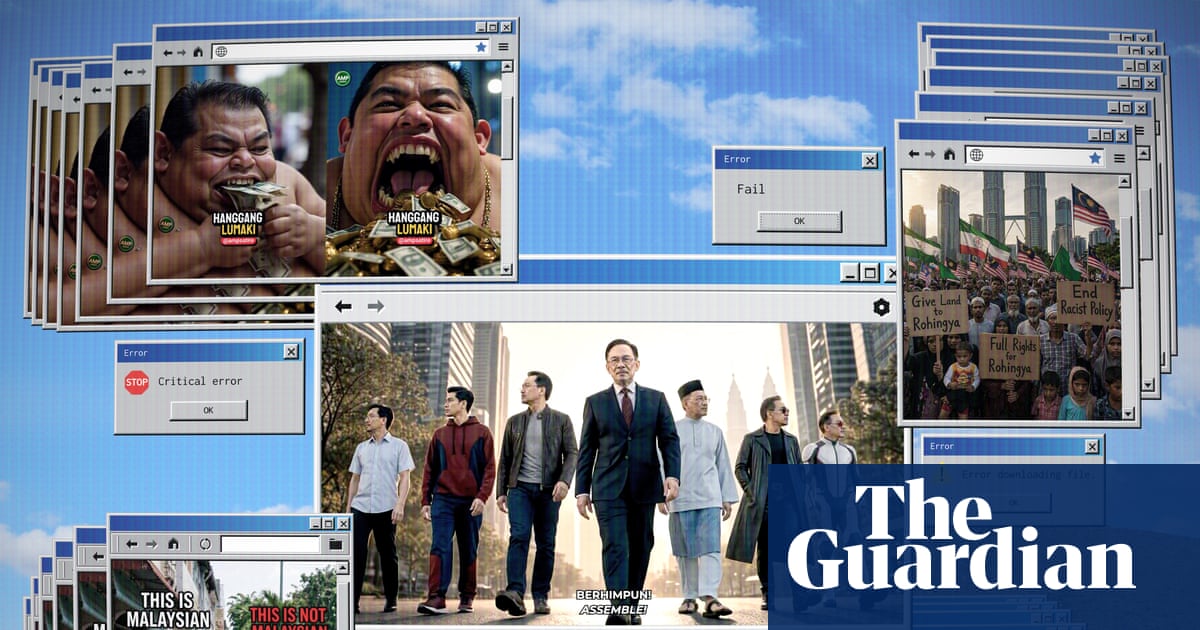
Years ago it would have been an elaborate operation involving any army of cyber troops creating fake news websites, social media accounts and forged dossiers, all deployed to spread disinformation en masse. In a worrying sign of how AI could “supercharge” fake news, Anthropic recently revealed how Claude AI was used in a political influence operation in Malaysia. It created a commercial election manipulation platform, utilising a network of about 1,000 X accounts, a fake news outlet called “Malaysia Pulse” and a series of fabricated documents.
The operation appeared designed to target voters in in recent state elections, pulling in census and electoral data to exploit sensitive political and social fractures, including race, religion, and royalty across all 222 Malaysian parliamentary constituencies. The experiment was ultimately ineffective once Anthropic stepped in but has sparked alarm about how AI could be weaponised in future elections in south-east Asia, a region already deeply vulnerable to fake news. Katie Harbath, who formerly worked on public policy for global elections at Meta, says the case is an example of how AI brings a new level of sophistication and ease to the disinformation landscape.
The report revealed how actors used Claude to build networks of fake social media profiles and news websites that targeted audiences on six continents. Anthropic said the actors included “governments, state-aligned propaganda institutions and state media, as well as private firms selling influence”. South-east Asia is no stranger to disinformation.
In recent years Nobel laureate and Filipino journalist Maria Ressa has likened the Philippines to a “petri dish” for the weaponisation of disinformation and fake news, with techniques tried and tested in the south-east Asian nation later successfully replicated in the west. So you don’t need 10 people to create a narrative or a story. You can just prompt it and then have it propagated.” Last year OpenAI banned accounts using AI to generate comments about Philippine politics and public officials across social platforms, with many fictitious comments generated in support of President Ferdinand Marcos Jnr.
Across south-east Asia, home to nations with predominately young and hyper connected populations, some fear the divisive potential of AI on social media. Already in the region, AI has been effective. In Indonesia, an AI-generated cartoon image of now-president Prabowo Subianto that helped soften his strongman image became wildly popular in the 2024 election.
It has also been used to inflame tensions, such as inciting hatred toward ethnic Rohingya refugees who fled to Malaysia from Myanmar during the civil war, says Dr Ben Loh, a media lecturer at Monash University Malaysia. The Anthropic report notes that the fake news outlet scraped legitimate Malaysian reporting and had the model rewrite it several times before republishing it under fabricated bylines. It also republished articles from Russian and Chinese state-aligned foreign outlets, including TV BRICS, Xinhua, Sputnik/RIA, and CGTN, stripping them of attribution.
Extract — continue reading at the source.