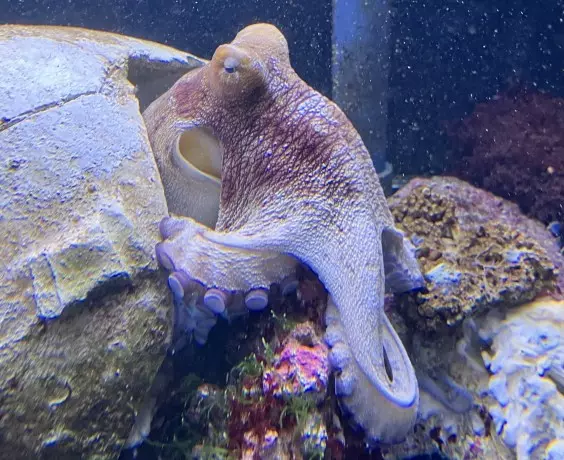
We’ve long known that octopuses have an uncanny ability to squeeze through small spaces. Whether they prefer beer cans or beer bottles, they’re adept at compressing their bodies to escape danger. A new study published in the Journal of Experimental Biology uncovered some secrets of this octopus refuge behavior.
Lead study author Wenci Xin, a mechanical engineer from the National University of Singapore, and his coauthors from Italy and Austria conducted experiments with three subadult common octopuses (Octopus vulgaris) collected by fishermen in France as well as four juvenile Mexican four-eyed octopuses (Octopus maya) raised from eggs in the lab. In multiple trials, each octopus was challenged with passing through a barrier in an acrylic box using either a large hole or a small hole relative to their eye distance. (Octopus eyes sit on either side of their head capsule and thus prove a good proxy for head capsule size.) Read more: “How the Rule-Breaking Octopus Is Rewriting the Evolution of Intelligence” When the hole was relatively large, the common octopuses used a three-step process to get through: 1) explored it with an arm; 2) pushed most of their other arms through; and 3) reached back with an arm to leverage the rest of their body and remaining arms through. By anchoring to the acrylic with their arm suckers, they were able to complete the whole maneuver in just 20 seconds.
When the hole was relatively small, however, they couldn’t put all their arms in at the same time and adapted to a four-step process. The first two steps were the same, but then, instead of dragging their remaining arms through in a bundle with their body, they first jimmied the arms through, followed by the head capsule. Interestingly, the Mexican octopuses rejected the small holes altogether, not even bothering to try to squeeze through them, instead sitting (sulking?) in the corner of the box.
That said, when a large hole was available, they readily adopted the same three-step strategy to pass through the acrylic barrier. Xin and the research team hope to apply the time-honed octopus’ strategies to the design of soft search-and-rescue robots, such that they can make it through tight spaces in disaster zones. In that case, octopuses wouldn’t just be saving their own lives by squeezing away from trouble, they’d be saving countless others as well.
Subscribe to our free newsletter.
Extract — continue reading at the source.