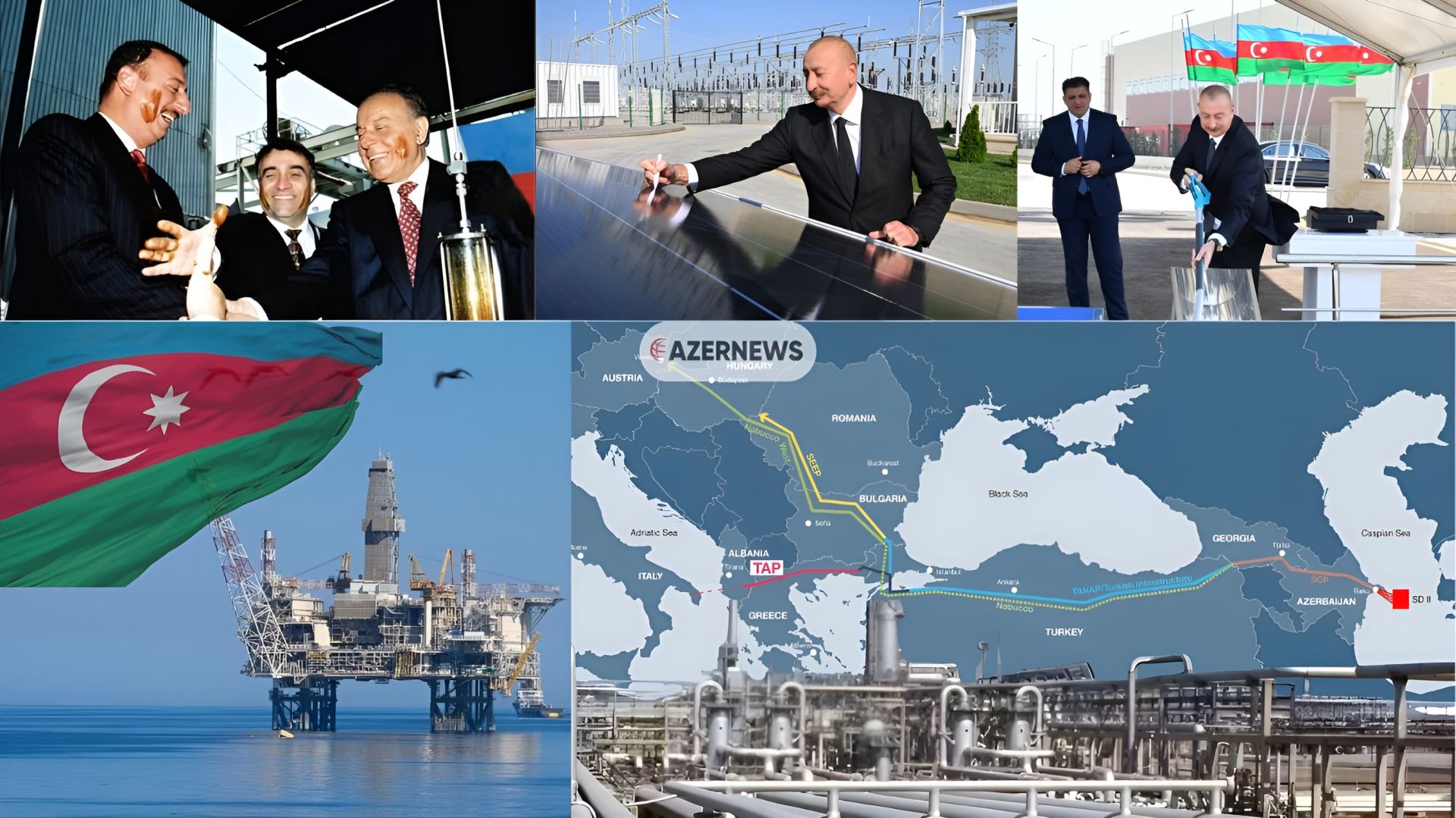
Azerbaijan is celebrating the 32nd anniversary of the "Contract of the Century." Looking back over the past 32 years, we can clearly see the visionary economic course of National Leader Heydar Aliyev and the resulting surge in the Azerbaijani economy. As is well known, the early 1990s went down in history as a period of deep political, social, and economic crisis for many post-Soviet states. Immediately following the collapse of the USSR, the disruption of centralized planned economic ties, hyperinflation, and the Karabakh conflict resulting from Armenia's military aggression completely paralyzed the Azerbaijani economy.
It is no exaggeration to state that during that period, Azerbaijan, with a total population of just 7 million, was hosting over 1 million refugees and internally displaced persons (IDPs). In other words, 1 out of every 7 people in the country was a refugee or IDP who had lost their home. Undoubtedly, all these factors severely impacted the national economy.
A look back at the first years of independence reveals that Azerbaijan experienced severe hyperinflation, with Gross Domestic Product (GDP) per capita standing at a mere 60 USD in 1992, which was a striking reflection of that socio-economic decline. However, macroeconomic stabilization measures and institutional reforms implemented from the mid-1990s onward fundamentally transformed the country's economic model. With the signing of the "Contract of the Century" on September 20, 1994, Azerbaijan brought its rich hydrocarbon resources to global markets while securing a massive influx of foreign direct investment.
This historic step laid the foundation not only for the energy sector, but for the reconstruction of the entire national economy. The trajectory observed in Azerbaijan’s foreign trade and macroeconomic indicators over the more than 30-year period spanning 1994–2026 represents a model of growth rarely seen in the global economy. In 1994, due to wartime conditions, stalled industrial enterprises, and a lack of direct access to world markets, Azerbaijan's annual exports amounted to just 652 million USD.
The strategic line inaugurated by the "Contract of the Century," the commissioning of global infrastructure projects such as the Baku-Tbilisi-Ceyhan (BTC) pipeline and the Southern Gas Corridor (SGC), along with the parallel promotion of the non-oil industry, sharply increased the country’s exports over the past 32 years. Compared to the 1994 figure, exports grew more than 38-fold, reaching 25 billion USD by 2025. In greater detail, the Compound Annual Growth Rate (CAGR) averaged over 12% during this period, a rate of dynamic expansion seldom encountered in global trade history.
To fully grasp the significance of these figures, it is helpful to compare them with Türkiye, currently considered a rising star both regionally and globally. It is worth noting that brotherly Türkiye was deliberately chosen for this comparison because it is well known to local audiences and continues to grow stronger day by day. This comparison makes the analysis even more compelling and grounded: Türkiye (1994–2025): Raised its exports from 18.1 billion USD to 273.4 billion USD, achieving an ~15-fold increase.
Extract — continue reading at the source.