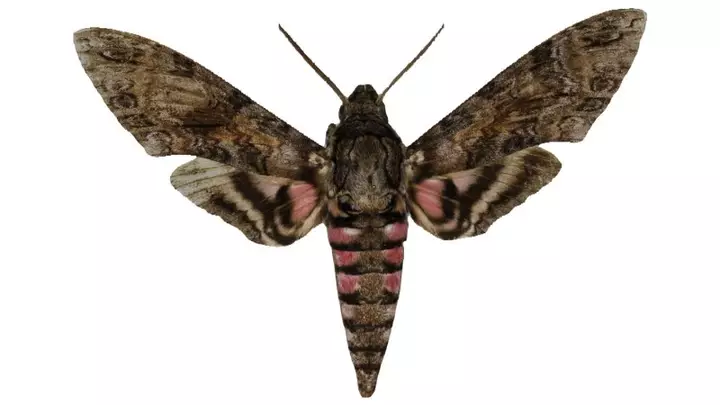
When a bat closes in, some hawkmoths fight back with their genitalia. By rasping specialized scales on their sex organs against structures on their abdomens, the moths unleash bursts of ultrasound that can scramble the sonar a hungry bat uses to lock onto prey. But this acoustic counterattack is no evolutionary one-off.
Relentless pressure from predators has pushed these otherwise tasty insects to reinvent this defensive tactic up to seven times throughout their evolution, with separate lineages arriving at distinct anatomical solutions to the same threat, researchers report November 4 in the Proceedings of the Royal Society B. The findings suggest that the high-frequency acoustic skirmishes playing out overhead each night, beyond the range of human hearing, may be far more varied than scientists realized. The discovery builds on more than a decade of research by sensory ecologist Jesse Barber, now at the American Museum of Natural History in New York City, and entomologist Akito Kawahara of the Florida Museum of Natural History in Gainesville.
Those scientists’ earlier work showed that moths across multiple families, from tiger moths and fruit-piercing moths to geometer moths and jewel caterpillar moths, produce ultrasound in response to bat attacks. Other insects, including some beetles and fireflies, do too. But among the most striking defenders are hawkmoths, a family of some 1,600 mostly nocturnal, torpedo-shaped speedsters, also known as sphinx moths, that hover at flowers like hummingbirds.
Many fend off bats by scraping their genitalia like a fingernail dragged along a comb, producing ultrasonic clicks that can disrupt the predators’ sonar. The anatomical diversity of these sound-producing systems, however, and how they evolved remained poorly understood. So Barber, Kawahara and their team, including Florida museum colleague and evolutionary biologist Paul Masonick, combined audio recordings of male hawkmoths responding to bat calls with high-resolution imaging of preserved specimens from overlapping species.
Although some females also produce ultrasound, the researchers focused on males because female sound creation remains too poorly documented for systematic analysis. Among the 143 species tested, 77 produced ultrasound. They did so in three distinct ways.
All three rely on a patch of enlarged, football-shaped scales on the male’s genital valves, which are paired structures used to clasp females during mating. But what those scales scrape against varies. Some rub the scales against a row of corresponding scales near the rear of the abdomen.
Extract — continue reading at the source.