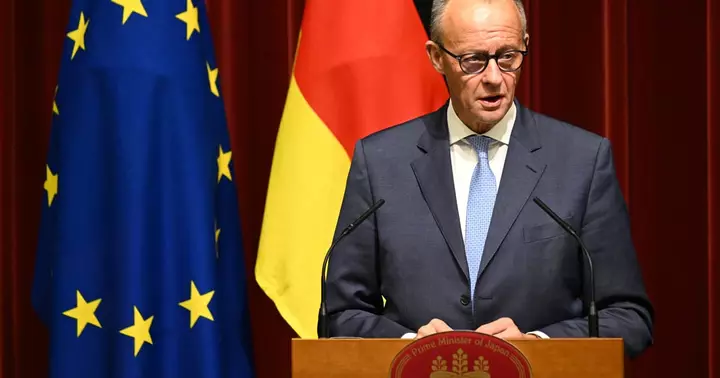
KOREAN DEMILITARIZED ZONE — Friedrich Merz ended his five-day trip to Asia on Friday reflecting on Europe's past. After visiting the blue barracks where the armistice that ended the Korean War was signed in 1953, in the Joint Security Area where North and South Korean troops stand face-to-face, the German chancellor addressed the obvious parallels between his country's history and Korea's present. "Thoughts are running through my mind about how grateful we may be that in Germany we haven't had to experience this for 36 years," Merz said.
The remarks concluded a tour of Singapore, Japan and South Korea, where the chancellor was challenged by Asian capitals over security and trade cooperation — and often reminded of how the region's turmoil are intertwined with Europe's precarious moment. One only has to look across the border. Shortly before Merz arrived in the demilitarized zone, North Korea fired about 10 short-range ballistic missiles toward the Sea of Japan.
The chancellor's greatest security concerns at home — Russia’s war against Ukraine and Moscow’s threat to Europe — are increasingly becoming problems in the Asia-Pacific region as well. The fact that Pyongyang is able to launch so many ballistic missiles, testing and expanding its long-range strike capabilities, is directly linked to its cooperation with Russia. North Korea has been sending soldiers to the Russian front in Ukraine for two years and in return benefited from combat experience and technology transfers.
North Korean state television on Thursday showed leader Kim Jong Un with new military drones, including a potential stealth drone, underscoring the great strides the country is also making in drone development. These are serious security issues that other countries in the region, including Japan, cannot ignore. Besides provocations from Pyongyang, there is China, which is not only becoming increasingly dominant in trade but also casting its eye toward Taiwan, making far-reaching territorial claims in the South China Sea and putting strong pressure on critics such as Japan.
And there is Russia, which is forging close military ties with Beijing and carrying out joint bomber flights with the Chinese air force near the Japanese border. This German offer has generated considerable interest. Given Berlin’s position as Ukraine’s largest supporter, German defense companies are highly active in the war-torn country and cooperate with local manufacturers, giving them access to rapid technological developments.
This makes them attractive to Asian partners who fear falling behind North Korea and China as they benefit from their cooperation with Russia. The fact that the chancellor traveled with a large business delegation — the kind previously seen only on visits to China — underscores this focus. Among the companies were several defense firms, including aircraft manufacturer Airbus, air defense manufacturer Diehl Defense and drone specialist Quantum-Systems.
Extract — continue reading at the source.