"Exercise is the best antidepressant," people say — and clinically it is one of the most reliable. But which signal crosses from the leg to the brain stayed a black box. Jiasui Yu and Suk-Yu Yau at the Hong Kong Polytechnic University name a molecule: apelin, a "myokine" — a chemical letter that working skeletal muscle releases into the blood.
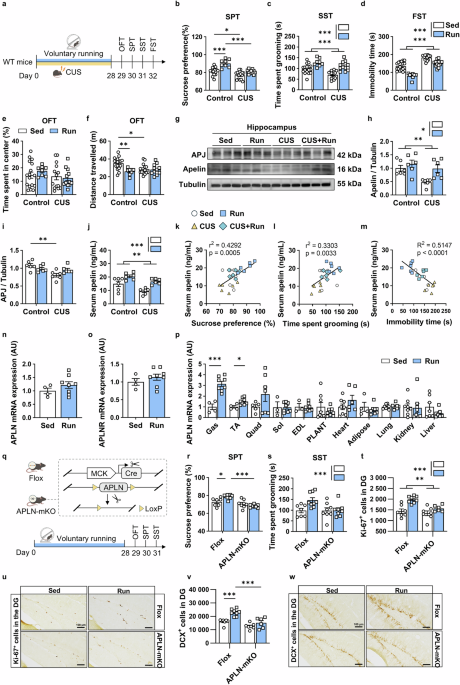
Under chronic unpredictable stress, mice showed sharply lower apelin and its receptor APJ in the hippocampus. Four weeks of voluntary wheel running reversed the depression-like behaviour and restored apelin in blood and hippocampus, sourced from the calf muscles. Two tests nailed it down.
Switching off the apelin gene only in skeletal muscle abolished running's antidepressant effect. Boosting apelin in muscle, with no running, reproduced the benefit in normal mice. Mechanistically, apelin acting on APJ receptors strengthened NMDA-receptor neurotransmission on hippocampal neurons and promoted new neuron growth.
It is mice, not people, and no one should stop exercising in favour of a future pill. But it turns a vague slogan into a traceable pathway — and hints at help for patients who cannot exercise. Source: Yu & Yau et al., Molecular Psychiatry, 2026 — nature.com/articles/s41380-026-03651-y.
Extract — continue reading at the source.