Today, written notes are such a large part of a Western musical education that the word “music” has often come to mean exactly that: sheet music or a printed score. Musicians and their teachers set great store by literacy: by the ability not only to read and write music but also to sight-read a score in real time, in the same way that we read and write words and numbers. But it hasn’t always been this way.
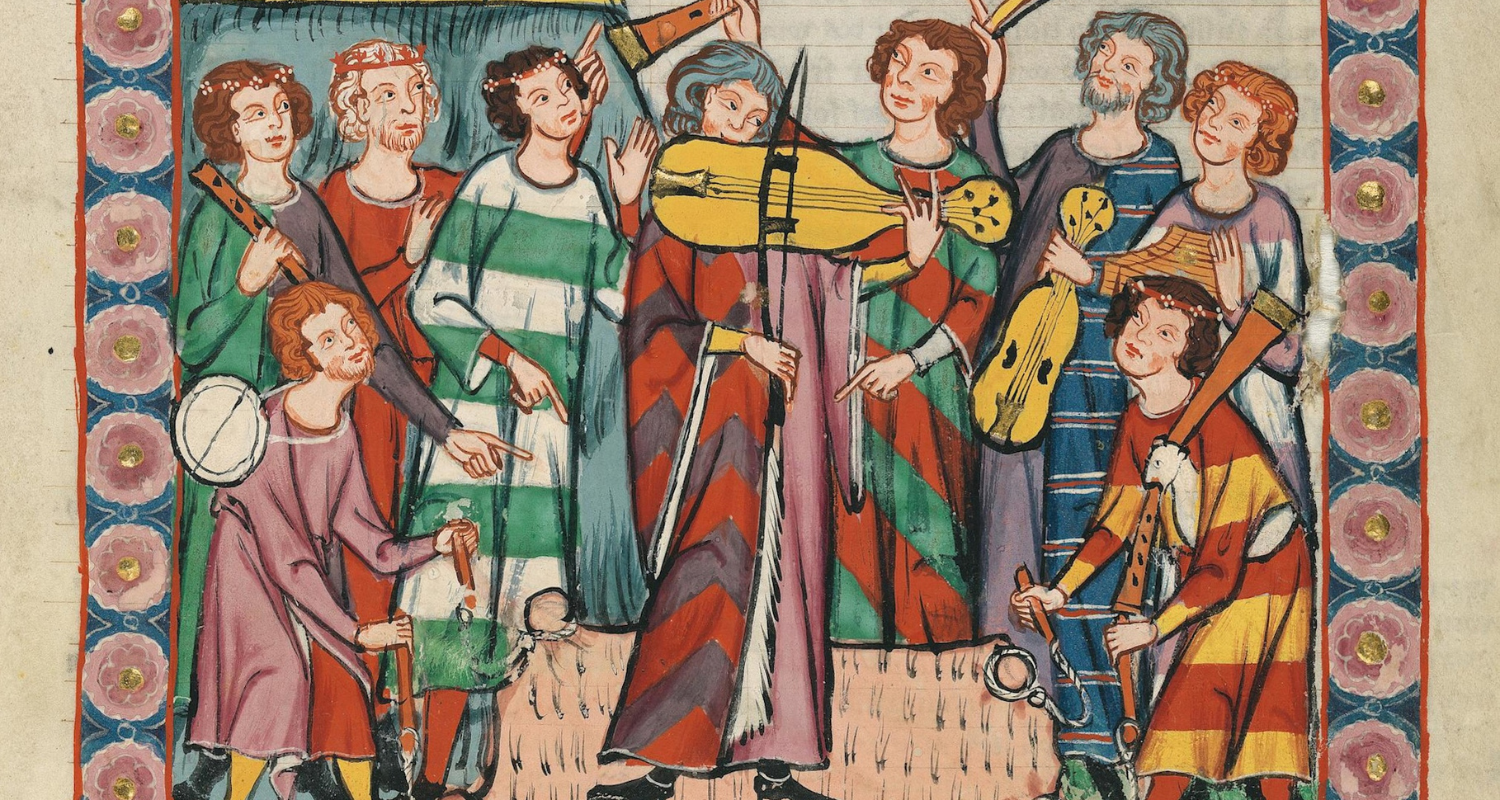
It’s time now to take a closer look at music at an important moment of transition, to see how some of its very earliest written forms might play into the history and prehistory of performance. Since time immemorial, people in Europe had been playing and transmitting songs and tunes, lyrics and melodies, from memory. But about ten centuries ago, as the people of Schleswig were tuning up their bone flutes, something new happened.
For some people the oral tradition no longer seemed sufficient, and instead they began to visualize ways of writing down tunes. On the written page, verses came to be annotated with sequences of undulating lines and dots, in which the direction of the text, from left to right, indicated the passage of musical time, and the up-and-down motions of the pen represented the rise and fall of the melody. They were the first experiments in the analog representation of sound signals in real time.
Teeming with alliteration and assonance, and overflowing with cryptic references and metaphors…the two poems are like two peas from the same pod. Back in the ninth and tenth centuries, monkish scholars in the British Isles and continental Europe began to write down traditional stories from their remembered past, and they left us some wonderful material in a variety of European languages. Our challenge today is to work out how they were meant to be read.
The most famous of their early medieval narratives in Old English is the tale of Beowulf. The version of the story that survives was composed at around the end of the ninth century and consists mostly of plain text, handwritten in ink on faintly ruled white parchment, the pages subsequently stitched together in a leather-bound volume. Today the lines look like prose, forming a continuous text with no hint of structure in the layout and no telltale end rhymes to interrupt the flow.
But when you read them out loud a pattern begins to emerge. Unlike verses of later ballad traditions, collected in the nineteenth and early twentieth centuries, Old English poets rarely used any kind of rhyme and appear not to have followed a regular meter or rhythm. Instead they’ve relied on alliteration and assonance, and shifting patterns of stress.
Extract — continue reading at the source.