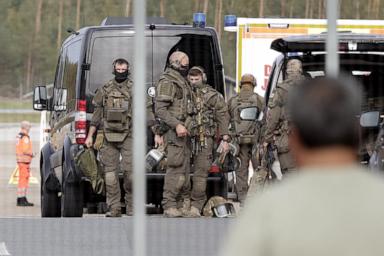
New Delhi, India – Central parts of the Indian capital have been flooded in recent days with thousands of armed personnel, chasing down young protesters demanding the resignation of the country’s chief election commissioner (CEC) and struggling to secure a place to stage a sit-in in New Delhi. Since last week, several student organisations and a wide spectrum of opposition parties have been engaged in a tactical tug-of-war, with tens of thousands turning up on Monday, far outnumbering police personnel. Protesters are demanding sweeping reforms and the resignation of CEC Gyanesh Kumar after revelations of election irregularities.
The agitation marks the latest challenge to Prime Minister Narendra Modi’s grip on power, after his education minister was forced out by the same group of demonstrators less than three months ago. The Modi government has tried to portray protesters as representing antinational interests, working to slow down India’s growth or even to enable its breakup. But India, the world’s most populous country, has had a long history of street protests, from its freedom struggle against the British Empire to waves of movements during the 79 years of the Indian republic that have shaped its modern identity.
India’s newly-formed constitution envisaged Hindi replacing English as the central government’s official language after a 15-year transition, ending on January 26, 1965. Many people in southern India, particularly Tamil speakers in the then Madras state (now Tamil Nadu), feared that this would sideline them in government employment, civil service examinations and dealings with the central administration. For the federal government of a vast and diverse country, the idea of one common official language of communication was attractive as a tool of unification.
But for many of the ancient societies that had agreed to come together under the Indian Union, this led to fears of cultural domination by the Hindi-speaking north of the country. Demonstrations by several student organisations, opposing the imposition of Hindi, broke out, often leading to clashes with the police. The Dravida Munnetra Kazhagam (DMK), a regional political party advocating Tamil nationalism, led by CN Annadurai and M Karunanidhi, spearheaded the protests.
In January 1965, Annadurai was arrested on the eve of an anti-Hindi agitation. Two young supporters immolated themselves, and Hindi books were burned. Then-Prime Minister Lal Bahadur Shastri assured protesters that English would continue to be used alongside Hindi.
The DMK won Tamil Nadu’s state election in 1967, ending the until-then dominant Congress party’s rule in the state. It was one of the defining moments of Indian federalism and regional identity in a young nation. English has remained one of India’s two official languages — and the Congress party has never returned to power in Tamil Nadu on its own.
Extract — continue reading at the source.