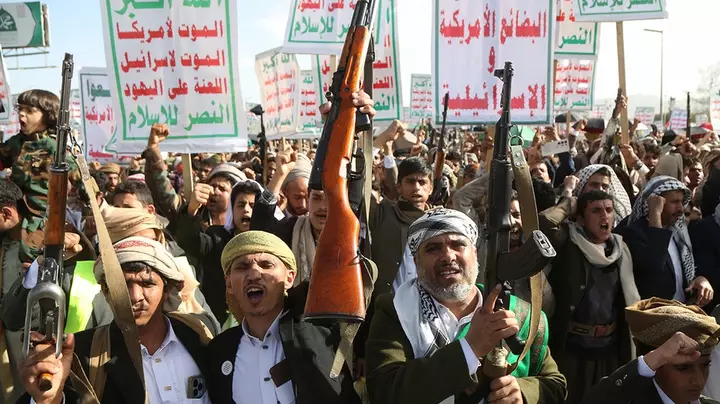
Saudi Arabia is turning to foreign allies to fend off Houthi missiles and drones, exposing a military vulnerability that could soon become President Donald Trump's problem. Britain announced Tuesday it would send Typhoon fighter jets to defend Saudi cities and critical infrastructure, Egypt is already assisting the kingdom and Israel has offered to step-in to help. Riyadh, meanwhile, is asking Washington for more interceptors, and Trump is weighing whether the U.S. should intervene and strike the Iran-backed Houthis directly.
The reinforcements could help shield Saudi cities and critical infrastructure. They do little, however, to eliminate the Houthi launchers and weapons threatening them from Yemen. SAUDI FOREIGN MINISTER WARNS HOUTHI THREAT GOES GLOBAL AS TRUMP HOLDS FIRE "The theme right now, I think, is defensive or defensive-minded," Jason Campbell, a senior fellow at the Middle East Institute, told Fox News Digital.
The question, he said, is whether that evolves into something "more offensive or kinetic." The Houthis have already demonstrated their ability to punch through Saudi defenses. Their strikes and attempted strikes on the kingdom more than doubled in a single week this month, according to the Armed Conflict Location & Event Data Project, with airports in Riyadh, Jizan, Najran, Dammam and Abha targeted since Oct. 5. SAUDI ARABIA ON EDGE: ICONIC KINGDOM CENTRE SENDS WORKERS HOME AMID HOUTHI ATTACKS The most devastating barrage struck King Khalid International Airport in Riyadh, killing at least 13 people and wounding more than 300.
Other attacks have targeted Saudi energy infrastructure, turning the Houthi campaign into a threat not only to the kingdom's security but also to the economic stability Riyadh has spent years trying to project. Saudi Arabia has spent decades building one of the region's most sophisticated militaries. Riyadh spent an estimated $83.2 billion on defense last year, making it the eighth-largest military spender in the world, according to the Stockholm International Peace Research Institute.
Its arsenal includes U.S.-made F-15 fighter jets, Patriot missile defenses and advanced radar systems. Yet the Houthis are exploiting a mismatch between the defenses Saudi Arabia and its partners spent years building and the weapons now coming at them. Campbell said the U.S. and its regional partners had been comparatively well prepared to confront the higher end of Iran's arsenal, including ballistic missiles and other advanced weapons.
PENTAGON RACES TO BUY 10X MORE MISSILES AS IRAN WAR DWINDLES ARSENAL, THREATENS READINESS FOR CHINA AGGRESSION "What the region was decidedly less prepared for was an array of lower end of the spectrum ... threats posed by Iran and now the Houthis," Campbell said. The volume is part of the problem. Campbell said Saudi Arabia and other U.S. partners have burned through significant numbers of high-end interceptors against ballistic missiles and other threats, while lower-flying weapons can also challenge radar and early-warning systems that were not necessarily designed or calibrated to detect them.
Extract — continue reading at the source.