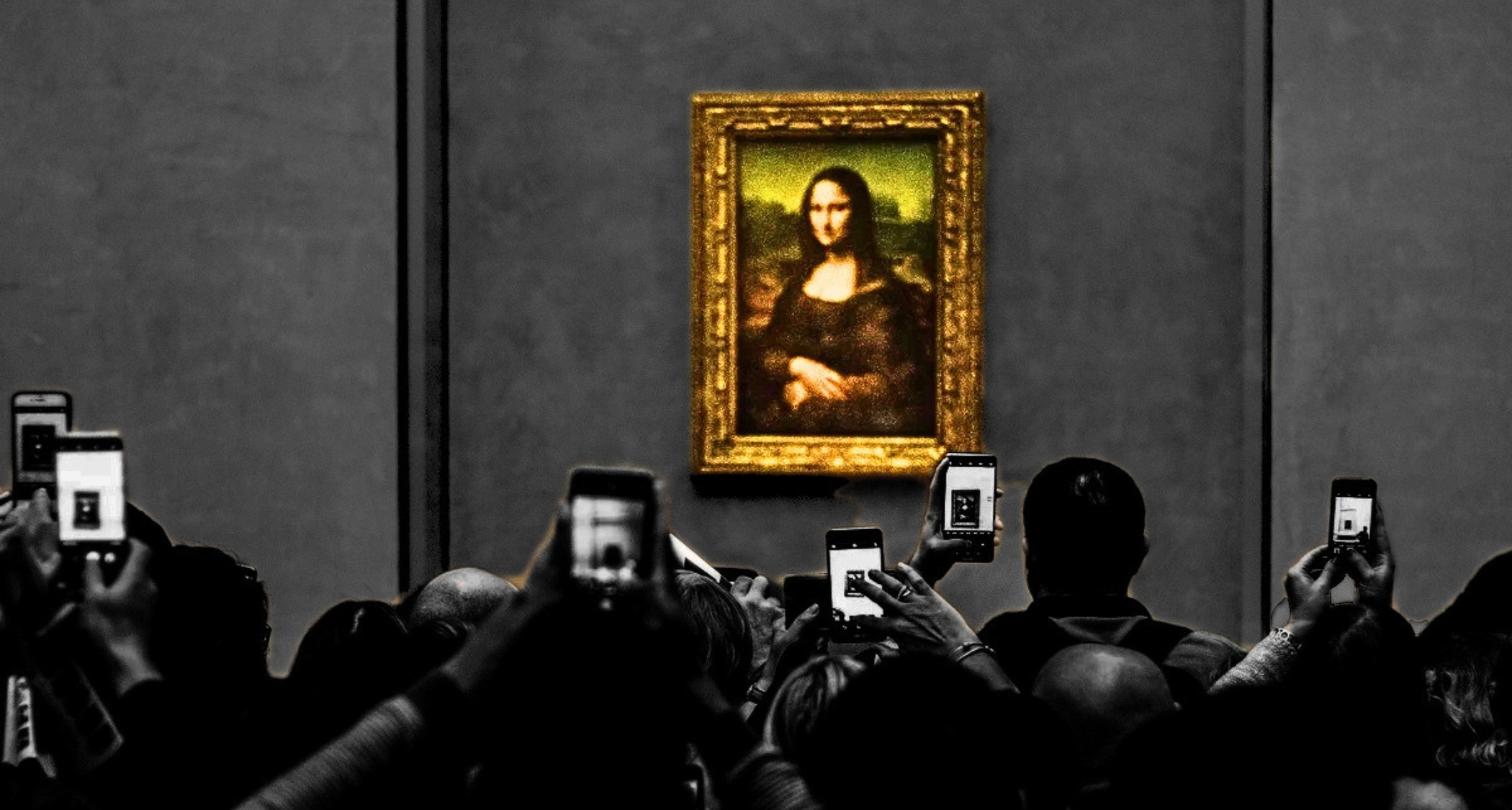
When I visited the Louvre Museum in Paris, I was struck by how small the Mona Lisa looked in person—a common reaction—and by how most of the people in the room were not looking at the painting itself. They were frantically trying to get pictures of it on their phones, sometimes with themselves in the frame, sometimes not. It seemed futile, especially given the reflections caused by the thick protective glass that encases Leonardo’s famous work.
Many could barely see the painting clearly with their own eyes, yet they were focused on capturing it. If asked before arriving what their goal was in visiting the museum that day, a likely answer would have been that the point of the visit is to witness the art. In fact, the behavior I describe is more akin to witness themselves witnessing art.
Susan Sontag once observed that a photograph does not tell us what the thing looks like, only what a photograph of the thing looks like. In that crowded gallery, I saw an entire room of people trading the thing itself for the image of the thing, convinced that the capture was more valuable than the contact. The experience had already been translated into something shareable before it was fully experienced.
The moment you become visible, the reflection starts talking back. One could argue that the camera is simply recording the moment, but the truth is that the camera is redefining the purpose of the moment. This pattern repeats everywhere.
At concerts, the front rows glow with raised screens. Fans watch the performance through their cameras, checking their framing while the musician performs, sometimes as close as only a few feet away. At scenic overlooks, people turn their backs to the landscape to stage a selfie photograph.
At restaurants, plates grow cold while lighting is adjusted and angles are tested. At children’s school performances, parents watch their child through a phone screen even though the child is directly in front of them partaking in an event that will only happen once. The common thread is that these behaviors are more about verification than they are about documentation.
Extract — continue reading at the source.


/https://tf-cmsv2-smithsonianmag-media.s3.amazonaws.com/filer_public/c0/f5/c0f59bee-c356-407a-b6c2-e5ca8c726ae4/02_eisenbarren_auswahljpg__975x1201_q85_crop_subsampling-2jpg.webp)