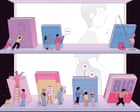
Did the cover grab you, were you swayed by the quotes on the front, or did you just happen to spot it on an appealing table as you walked into the shop? Did you think about all the nudges that led you to that decision – by the publisher, the bookseller or that person you follow on Insta? The reality is that our reading choices are directed and massaged at every turn.
And who are the persuaders? They’re the booksellers, the supermarket stock buyers, the publishing houses and their ranks of marketers and publicists. And, more recently, persuasion often comes from BookTokers and online influencers, social media videos, podcasts and Instagram posts.
How is all this changing publishing? We all judge books to some extent by their covers, but did you know how much thought goes into finding just the right cover, colour, font and design? These covers are focus-grouped, shown to supermarket buyers and often changed at their behest, according to Jamie Keenan, one of Britain’s leading book designers.
Nice bright colours and big type,” he adds. When I shared a photo on Instagram, a number of authors messaged me. And then there are the increasing numbers of copycat covers, so that every cosy crime novel suddenly looks like Richard Osman’s bestsellers – cream background, coloured border, hand-lettering – and all heartwarming Japanese books have to feature a cat. (At his last publishing house, says Gwyn Jones, for Japanese fiction “there was this unspoken imperative to put a cat on the cover even if there wasn’t a major role for a cat in the book.
It did seem to make a difference.”) “You quite often get briefs on what are called comparable titles,” Keenan says. That’s the work of copywriters. One of their tricks is to use Christopher Booker’s book The Seven Basic Plots.
It gives you tools to tell the story of the book in different ways. You want to say: ‘It’s the same but different.’” What if an author isn’t writing what’s on trend right now? Now cosy crime is absolutely everything.
Extract — continue reading at the source.