Although it was met with mixed reviews and modest commercial success upon its release, McTeigue’s adaptation of Alan Moore’s graphic novel of the same name has never truly left the zeitgeist — and there are a couple of reasons. The first has to do with the film’s themes. Moore’s graphic novel — written in the 1980s and illustrated by David Lloyd — attacked the Conservative government of “Iron Lady” Margaret Thatcher.
When the film version came out, many viewed it as a critique of Bush-era illiberalism in the wake of 9/11. And with today’s anxieties about mass surveillance, authoritarian tendencies, and national leaders attempting to control media, it’s not hard to see why the film still resonates with audiences two decades after its release. The second reason has to do with the film’s audience and imagery.
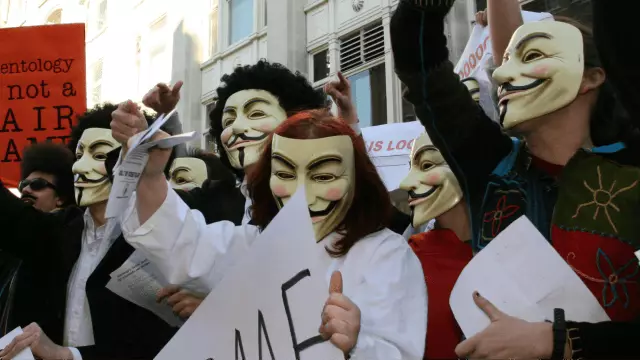
A testament to the eponymous vigilante’s iconic exclamation that “ideas are bulletproof,” his grinning, mustachioed Guy Fawkes mask has become a popular sight at demonstrations across the globe, from the U.S. and Venezuela to Saudi Arabia and Hong Kong. But how did this happen, and what does it mean? To understand what the Guy Fawkes mask means to real-world rebels, we first have to understand what it means to V the character.
As the film briefly calls upon us to “remember,” Fawkes was executed for his involvement in the 1605 Gunpowder Plot: an unsuccessful attempt by Catholic conspirators to blow up the House of Lords and assassinate the Protestant King James. To commemorate its failure, the day the plot would have taken place — November 5th — was later declared a public holiday. Fawkes, who had been assigned the job of lighting the gunpowder, was not only burned in effigy, but over time, people also started wearing masks that caricatured his distinct appearance.
The meaning of this holiday changed. What began as a sober commemoration of a solemn event evolved into a night of bonfires and fireworks, and feelings associated with Fawkes shifted from negative to positive. By the time the Industrial Revolution rolled around — and English Catholics had been officially emancipated — Fawkes was seen less as a villain than as a folk figure.
Four issues delivered, plus every article, video, and event unlocked and ad-free. This is also how V seems to see Fawkes. Though the character never really explains why he chose this particular figure as his revolutionary alter ego, his preoccupation with Fawkes’ larger-than-life (and, frankly, different-from-life) reputation rather than the man himself underscores his belief that symbols are more powerful than people.
Extract — continue reading at the source.