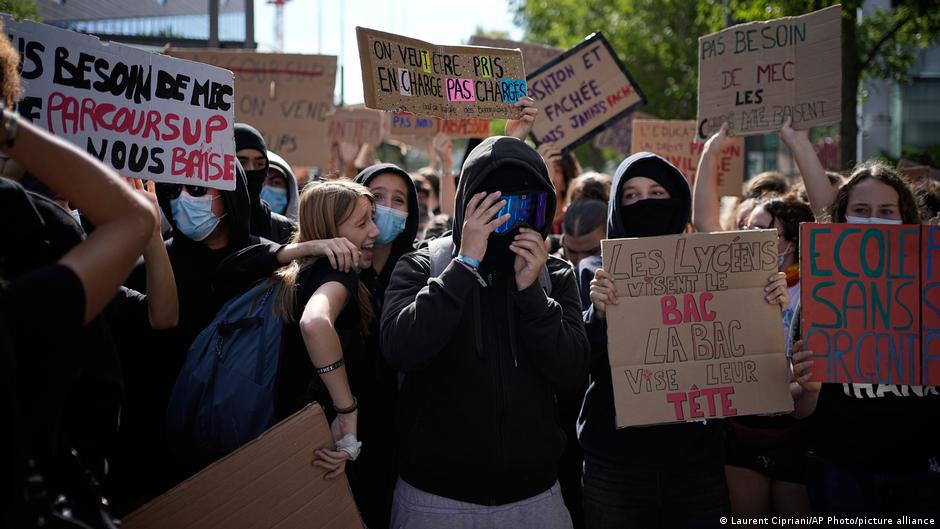
Several hundred schools in France will close totally or partially on Monday amid security fears following a wave of nationwide student protests, the education minister has said. The protests by pupils complaining of poor conditions began at one Paris school on September 17 but last week mutated into sometimes violent demonstrations across the nation. To view this video please enable JavaScript, and consider upgrading to a web browser that supports HTML5 video Education Minister Edouard Geffray said on Sunday that lessons would be totally or partly suspended" in some "400-500" high schools on Monday, as the security conditions "have not been fulfilled." According to Geffray, the schools were being closed mainly as a precaution, with more large protests planned for Tuesday.
Geffray said the number of schools remaining closed on Monday would be similar to that on Friday but that there was planned to be a "partial, progressive return to lessons." He said 24 schools had been "burned or ransacked" and 78 education staff members injured since the protests began. "There are activists — particularly from the far left — who have infiltrated the high school student movement, hijacked it from the students themselves, and engaged in extreme violence," Geffray said. "Clearly, this poses a risk to both our staff and our students," he added.
Valerie Pecresse, the president of the Ile-de-France region surrounding the capital, said that more than a third of the 468 schools in the region would be shut on Monday. The protesting teenagers at French high schools, called lycees, have complained of high rates of absenteeism by teachers, school days that are too long and dilapidated facilities. They have also protested at the lack of adequate cooling on hot summer days, with some towns seeing temperatures of 40 degrees Celsius (104 Fahrenheit) last summer in a country without widespread air conditioning.
Organizers have called for the protests to continue on Tuesday, saying the government was still failing to propose "concrete measures" to remedy the situation. On Sunday, Prime Minister Sebastien Lecornu urged local authorities to make it a priority to fill gaps left by long-term absences and unfilled posts. He also called a meeting for Tuesday with regional presidents to discuss renovating school buildings that are often in poor condition.
The protests have been marked by several violent incidents, with security forces sometimes using tear gas and batons to disperse the young protesters. More than 5,000 people, 85% of them minors, have been arrested since the start of the movement. On Sunday, a 16-year-old was detained after a 59-year-old teacher was hit and doused with gasoline on the sidelines of a protest in the southern town of La Ciotat.
Last week, a group of young people was filmed beating and kicking a policeman on the ground in the eastern town of Belfort. The French branch of rights group Amnesty International last week described the action taken by police as "disproportionate." Interior Minister Laurent Nunez has, however, defended security forces, saying they were "not cracking down on young people" but rather "protecting" school and university students wishing to "peacefully voice their demands." Don't let the algorithm hide the news. If you rely on our team for trusted reporting, please take a moment to select us as your Preferred Source on Google by clicking here and hitting the "star" or "preferred" button, so you'll always see our verified news first.
Extract — continue reading at the source.