The revelation is found in a tranche of documents obtained through a Freedom of Information Act request and published this week by Democracy Forward, a legal advocacy group. As well as revealing that DHS officials have investigated over 150 nonprofit groups in search of evidence they’re helping noncitizens register to vote, the documents show how Immigration and Customs Enforcement (ICE) is now central to federal voter fraud investigations. More specifically, Homeland Security Investigations (HSI)—one of ICE’s two major components—is spearheading the effort to uncover voter fraud, with its Innovation Lab (known internally as iLab) developing tools for agents.
ICE, it seems, wants to build “a system that is going to get good at determining how to find people to investigate and potentially bring action against,” Chinmayi Sharma, an associate professor at Fordham Law School who has closely tracked the ELITE tool, tells WIRED. ELITE was again mentioned in a July 7 email with an attachment named “Fraud WAR”—WAR typically refers to a weekly activity report—from a DHS worker who shared an update on the agency’s “election integrity investigations,” including the news that Connecticut, Georgia, Kentucky, Missouri, Michigan, and New Mexico had “been enriched by the iLab and are pending Palantir entry into ELITE.” What specifically was enriched and pending Palantir entry is unclear from the records, but in another email in the same chain, a DHS official said that someone from the agency would send the update to the White House. The White House did not comment on ICE’s possible use of ELITE to track noncitizen voters in a statement provided to WIRED.
Are you a current or former government employee who knows something we should know about voter fraud investigations—or anything else? We’d like to hear from you. Using a nonwork phone or computer, contact the reporter securely on Signal at DavidGilbert.01.
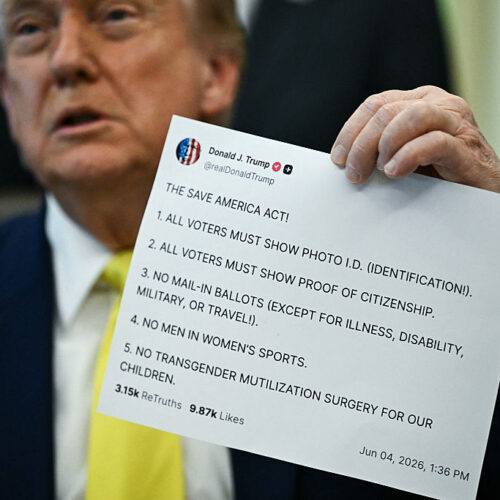
The claim that noncitizens are voting in numbers sufficient to sway the outcomes of US elections has been a central narrative pushed by the Trump administration in the run up to next month’s midterms. All available evidence shows that noncitizen voting is vanishingly rare. DHS, under secretary Markwayne Mullin, has led the charge on identifying noncitizen voters, but has so far only found a handful of possible cases.
Earlier this week, the Justice Department announced it had brought charges in 16 cases involving foreign nationals allegedly committing voting-related crimes. (All were lawful permanent residents.) Last month, a whistleblower alleged that federal employees directed by DHS leadership may have broken the law when they searched state websites for illegally registered voters. While Mullin and the Trump administration have been vocal with their claims about noncitizen voting and short-term victories ahead of the midterms, in the background, ICE appears to have been working on tools that will work in the long term. The May 26 email sent under a “Voter Fraud” subject line characterizes a weekly report as emphasizing “a network-based investigative approach, prioritizing organization and facilitation analysis over individual leads, now stated as a strategic direction.” The language used in the documents related to the agency’s new approach to identifying voter fraud suggests this system was not live or even in pre-deployment at the time, but rather being built for the future, Sharma believes.
There's just a lot of synergies you can take advantage of.”
Extract — continue reading at the source.