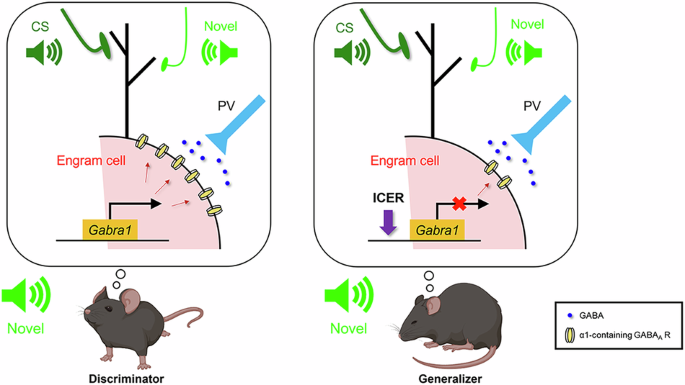
Fear discrimination—the ability to distinguish threatening stimuli from non-threatening ones—is an essential adaptive behavior, yet the neural mechanisms underlying individual differences in discrimination precision remain unclear. Here, we show that parvalbumin-positive interneuron (PV-IN)-mediated feedforward inhibition to fear engram neurons (ENs) in the lateral amygdala is selectively enhanced following auditory fear conditioning, driven by increased postsynaptic expression of α1 subunit (Gabra1)-containing GABAA receptors. Disruption of PV-IN activity during fear retrieval—via optogenetic or chemogenetic inhibition—or selective induction of inhibitory long-term depression at PV → EN synapses impaired fear discrimination, increasing freezing to novel tones while sparing responses to the conditioned stimulus.
Mechanistically, we identify inducible cAMP early repressor (ICER) as a transcriptional regulator that limits inhibitory plasticity by downregulating Gabra1 expression, thereby promoting fear generalization. These findings establish a previously unrecognized form of inhibitory synaptic plasticity that governs the precision of fear memory and suggest potential therapeutic targets for maladaptive fear overgeneralization in disorders such as post-traumatic stress disorder. Fear enables animals to associate environmental cues with aversive experiences and respond to potential threats.
In auditory fear conditioning (AFC), a neutral auditory conditioned stimulus (CS) is paired with an aversive stimulus such as a foot shock, leading to defensive responses, including freezing, upon later CS presentation [1,2]. While most individuals can discriminate the CS from dissimilar cues, some exhibit fear generalization to non-threatening novel stimuli [3,4,5]. This variability highlights the need to understand neural mechanisms that preserve fear memory precision.
Neural engrams are learning-activated neuronal ensembles that undergo enduring neuroplastic changes to encode memories [6,7,8]. In the lateral amygdala (LA), a critical site for fear memory formation, sensory inputs from thalamic and cortical pathways converge to associate environmental cues with aversive stimuli [9]. Although excitatory synaptic plasticity in LA engram neurons (ENs) is well established as a mechanism for fear memory formation and expression [10,11], the role of inhibitory synaptic plasticity in regulating EN activity remains unclear.
Emerging evidence suggests that inhibitory circuits and their plasticity are critical for sharpening memory specificity and preventing fear generalization [12,13,14]. In particular, feedforward inhibition (FFI), mediated by parvalbumin-positive interneurons (PV-INs), contributes to memory precision in the hippocampus and the amygdala [15,16], whereas disruption of inhibitory transmission or plasticity promotes generalized fear [17,18]. At the transcriptional level, cAMP response element-binding protein (CREB) regulates the expression of genes essential for synaptic plasticity and engram formation [19,20,21,22], whereas inducible cAMP early repressor (ICER) antagonizes CREB activity and can suppress genes involved in inhibitory plasticity, including Gabra1 that encodes the α1 subunit of GABAA receptors (GABAARs) [23,24,25].
In this study, we investigate how synaptic plasticity in AFC-activated ENs of the LA contributes to fear discrimination. Our study reveals that PV-IN-mediated FFI (PV-FFI) to ENs is postsynaptically strengthened after AFC to support fear discrimination, a process that is impaired in mice exhibiting generalized fear responses. Furthermore, we identify ICER as a key factor that disrupts inhibitory synaptic plasticity in ENs through suppression of Gabra1, thereby promoting fear generalization.
Extract — continue reading at the source.


