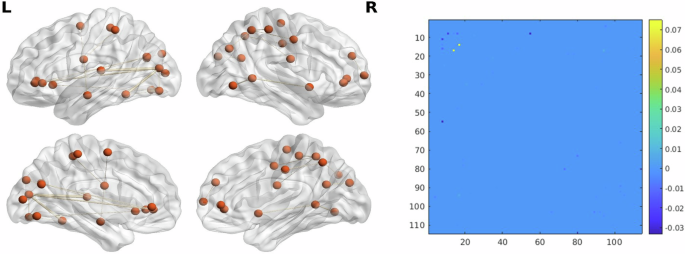
Trait social anxiety (SA) is continuous and can manifest across the entire spectrum of mental health, from subclinical levels in healthy controls to burdensome manifestations in major depressive disorder and finally full-blown disorders like social anxiety disorder (SAD). Although it has been proposed that SA is associated with deviations in the structural connectome, there is little research on the SA spectrum and its relation to abnormalities in brain structural networks. In this study, we aim to identify a structural brain network for SA across diagnostic groups using a transdiagnostic sample and connectome-based predictive modeling (CPM) to provide insight on neurostructural underpinnings of the SA spectrum.
We collected magnetic resonance imaging (MRI) and clinical data of N = 160 participants across an SA spectrum. Diffusion-weighted and T1-weighted structural images were used to reconstruct each participant’s structural connectome. We applied CPM to identify a structural brain network that predicts SA across diagnostic groups.
We further analyzed the structural connectome to investigate hubs and differences in global graph metrics between participants with and without SAD (noSAD n = 96, SAD n = 64). CPM revealed a brain network with 46 edges predicting SA across the SA spectrum with mean r = 0.141 (CI = [0.12, 0.2], p = 0.003). Hubs were located in the left pericalcarine, inferior-parietal, superior-parietal, right lateral-occipital cortex and pars orbitalis.
This study provides first evidence for a shared neurobiological foundation of SA across diagnostic groups and points towards a transdiagnostic relevance of SA and the related brain network. Trait social anxiety (SA) is a continuous phenomenon, with higher levels typically manifesting as social anxiety disorder (SAD). SAD is among the most prevalent anxiety disorders [1].
Without treatment, the course of SAD is usually chronic [2]. To better understand why some people are more socially inhibited than others and potentially disentangle trait SA-based manifestations, investigation of the neurobiological foundations of trait SA is warranted. This could improve the development and precise application of treatments, including prevention and early intervention by serving as a potential biomarker.
However, defining trait SA as a spectrum, especially in contrast to SAD, is complicated and has been subject of debate. SAD is characterized by excessive fear in and/ or avoidance of social situations, driven by the underlying concern to be embarrassed in front of and judged by others [3]. Though established as a diagnosis, distinction of SAD from personality traits, and subclinical manifestations is often debated [4, 5].
Extract — continue reading at the source.


