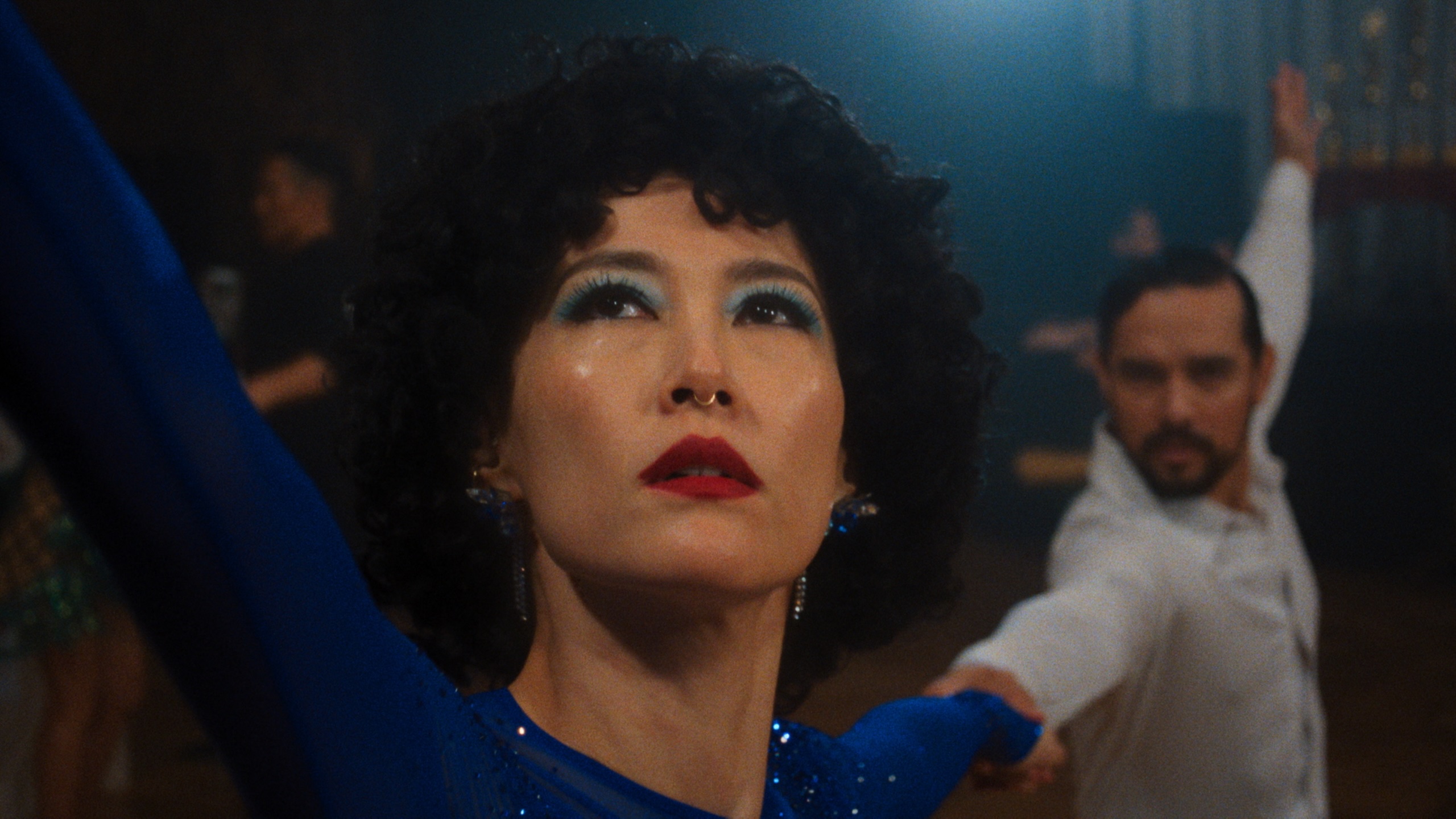
Grief does funny things to people; sometimes it even makes them a little crazy. That’s what happens to bereaved widow Haru, played by Rinko Kikuchi, in Josef Kubota Wladyka’s bittersweet comedy Ha-Chan, Shake Your Booty! Haru lives happily in Tokyo with her husband, Luis (Alejandro Edda), who’s also her dance partner—the two enjoy competitive ballroom dancing, a joyous physical representation of the relaxed, real-life romance that plays out at home.
Then Luis is taken from Haru. She stops seeing friends and family and, worse yet, stops dancing. Nine months later, when she’s finally persuaded to return to the studio for a class, a new instructor, Alberto Guerra’s Fedir, stops her cold: He’s a fantastic dancer, and handsome as a stallion.
A fling might be just what she needs. Or could it be the worst thing? That’s just the barest outline of Haru’s plight.
The movie Wladyka, along with his cowriter Nicholas Huynh, has built around her is a swirl of unchained desire, of fantasy dance sequences that unfold on ordinary Tokyo streets, and totally messy feelings. There’s no easy, one-size-fits-all way to navigate the loss of a loved one, just one of the truths that Ha-Chan, Shake Your Booty! navigates with warmth and humor. The movie is pleasing, if slight, though Kikuchi’s performance is nuanced enough to keep you watching, and to keep you rooting for her.
The intimacy between Haru and Luis is reflected in the warmth of the home they’ve built together—most notably a wall of LPs, fronted by a turntable, that serves as a kind of hearth, which makes sense for two people who love to dance. It looks like heaven, but for Haru it becomes a kind of limbo, a place where the dead and the living rub shoulders, sometimes uneasily. After Luis’ death, Haru can barely bring herself to face the music, either literally or figuratively.
She still feels his presence everywhere, and she sees it, too: he rather whimsically appears to her in the form a big black Tweety Bird with dark, shiny eyes. His human arms reach for her beneath his bird wings, and she allows herself to be enfolded in his embrace. It’s both a comforting place to be and one that’s a little dangerous.
Extract — continue reading at the source.