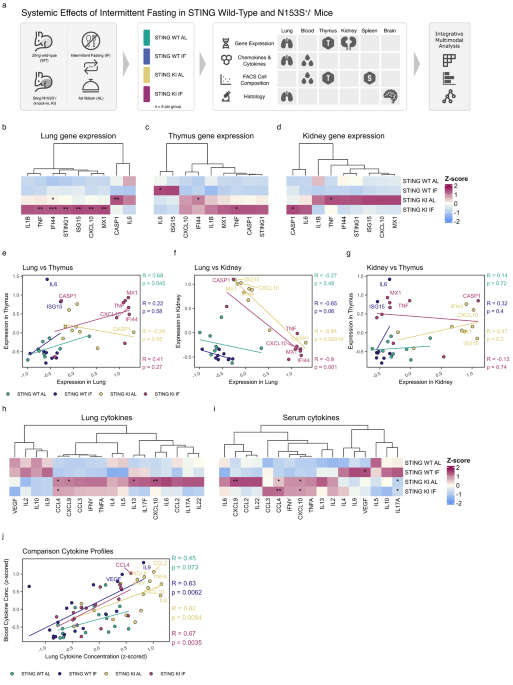
The cGAS–STING pathway is a central mediator of antiviral immunity, yet its constitutive activation causes severe systemic autoinflammatory disease and neurodegeneration. Intermittent fasting (IF) has been proposed as a non-pharmacological strategy to attenuate inflammation and neurodegeneration. We therefore performed a comprehensive study of how IF reshapes immune phenotypes and assessed whether IF mitigates pathology in mice carrying a constitutively active STING mutation (Sting N153S⁺/⁻).
Sting N153S⁺/⁻ mice and wild-type littermates were subjected to either an IF regimen (two 24-h fasting periods per week for 3 months) or ad libitum (AL) feeding and analyzed using gene expression profiling, cytokine and chemokine quantification, flow cytometry, histopathology, and machine-learning–based analyses across blood, lung, thymus, spleen, kidney, and brain. IF induced tissue-specific immunological changes, partially normalizing STING-induced alterations in immune cell composition, gene expression and cytokine levels in select peripheral organs. However, key TNF-dependent disease manifestations, especially lung pathology and dopaminergic neuron loss in the midbrain, were not ameliorated.
Furthermore, exploratory supervised and unsupervised multivariate analyses revealed distinct signaling patterns associated with genotype and diet. These findings demonstrate that IF modulates specific immune signatures at the levels of gene expression, cytokine production, and immune cell composition. Nonetheless, these changes were insufficient to ameliorate TNF-associated disease features driving pulmonary pathology and neurodegeneration in Sting N153S⁺/⁻ mice.
Together, these results underscore the importance of tailoring dietary interventions to the underlying disease mechanisms. A growing body of evidence links viral infections and proinflammatory immune responses to the development and progression of neurodegenerative diseases1,2,3,4. One key pathway involved in the detection of viral DNA is the cyclic GMP–AMP synthase (cGAS)–stimulator of interferon genes (STING) signaling cascade.
The cGAS–STING pathway senses cytoplasmic DNA, derived from pathogens or from aberrantly localized host DNA, and triggers the induction of type I interferons and proinflammatory cytokines5,6. Thus, the cGAS–STING pathway functions as a central signaling hub for a wide range of conditions, including autoimmunity, cancer, infectious diseases7, and neurodegenerative diseases8,9,10,11,12. Notably, we have demonstrated that constitutive STING activation alone is sufficient to trigger dopaminergic neuron loss and synuclein pathology, which are hallmarks of Parkinson’s disease (PD)13.
Several STING-induced effects were subsequently shown to depend on TNF signaling14. The cGAS–STING pathway is tightly regulated under physiological conditions, and gain-of-function mutations in Sting1 (Tmem173) gene cause the severe pediatric disorder STING-associated vasculopathy with onset in infancy (SAVI). The disease is characterized by interstitial lung disease, cutaneous vasculitis, lymphopenia and profound immune dysregulation15.
Extract — continue reading at the source.