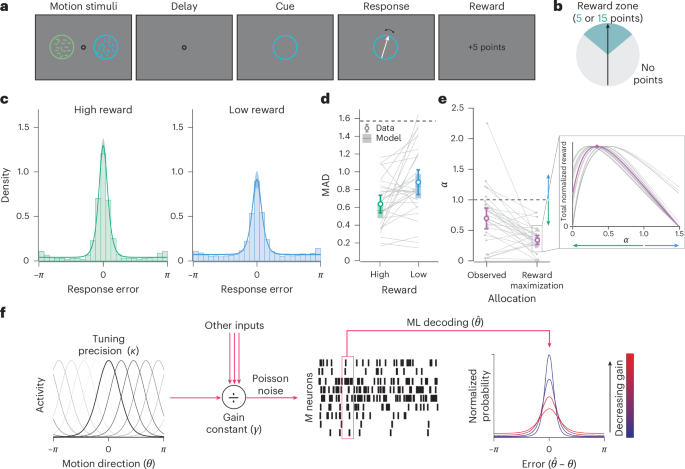
Humans and other animals prioritize visual processing of stimuli that signal rewards. While previous research has focused on tangible incentives (for example, money or food), the effects of intrinsic incentives—such as perceived competence—are less well understood. Here, across a series of visual estimation experiments, we manipulated observers’ subjective sense of confidence in their judgements using either deceptive trial-by-trial feedback or real discrepancies in stimulus reliability.
We found that observers prioritized encoding of stimuli associated with lower uncertainty or error, benefiting performance for stimuli already estimated accurately, while further impairing performance for those estimated poorly. These reward-driven biases, while potentially adaptive, impaired overall accuracy in the present tasks by causing resource allocation to deviate from the error-minimizing strategy. To account for these findings, we supplemented a normalization model of neural resource allocation with a simple reinforcement learning rule.
Intrinsic and external rewards cumulatively shaped the values assigned to different stimuli by the model, and the resulting discrepancies biased resource allocation and thereby estimation error, quantitatively matching the data. These findings reveal how intrinsic reward signals can shape resource allocation in ways that are both adaptive and counterproductive, offering a computational basis for the motivational biases underlying cognitive performance. To support adaptive behaviour and ensure survival, the brain has evolved to prioritize environmental cues that signal potential rewards1,2.
Selectively attending to reward-predicting stimuli facilitates efficient navigation of complex environments, helping organisms move towards more rewarding states3,4. This selection process is crucial given the brain’s limited processing capacity, as it enhances internal representations of valuable stimuli and facilitates the formation of stimulus–reward associations5. Whereas the bias towards processing stimuli associated with tangible rewards is well established, the influence of intrinsic rewards—positive motivational states associated with feelings of satisfaction and competence6—on sensory processing remains less understood.
Experiments using points-based and monetary incentives have found that associating stimuli with a higher probability, or greater magnitude, of external reward facilitates voluntary, or top-down, attention7,8,9. In addition, in visual search tasks, which primarily engage bottom-up processes, search times are faster for pop-out targets associated with higher rewards than stimuli predicting less or no reward10. Notably, the prioritization of reward-associated stimuli persists in subsequent tasks even when reward contingencies are removed, and previously rewarded features cease to be salient or task relevant11,12,13.
Consistent with this, studies have shown that eye movements are biased towards objects and spatial locations previously associated with rewards14,15,16. This continued prioritization of previously rewarded stimuli, even when it no longer aligns with immediate task goals, suggests that reward learning creates a lasting effect that can involuntarily bias attention towards these stimuli17,18. The influence of external rewards on behaviour extends to visual working memory (VWM)19, which is known for its ability to flexibly store and maintain features of multiple objects within a limited capacity20,21,22,23,24,25,26,27,28.
Extract — continue reading at the source.