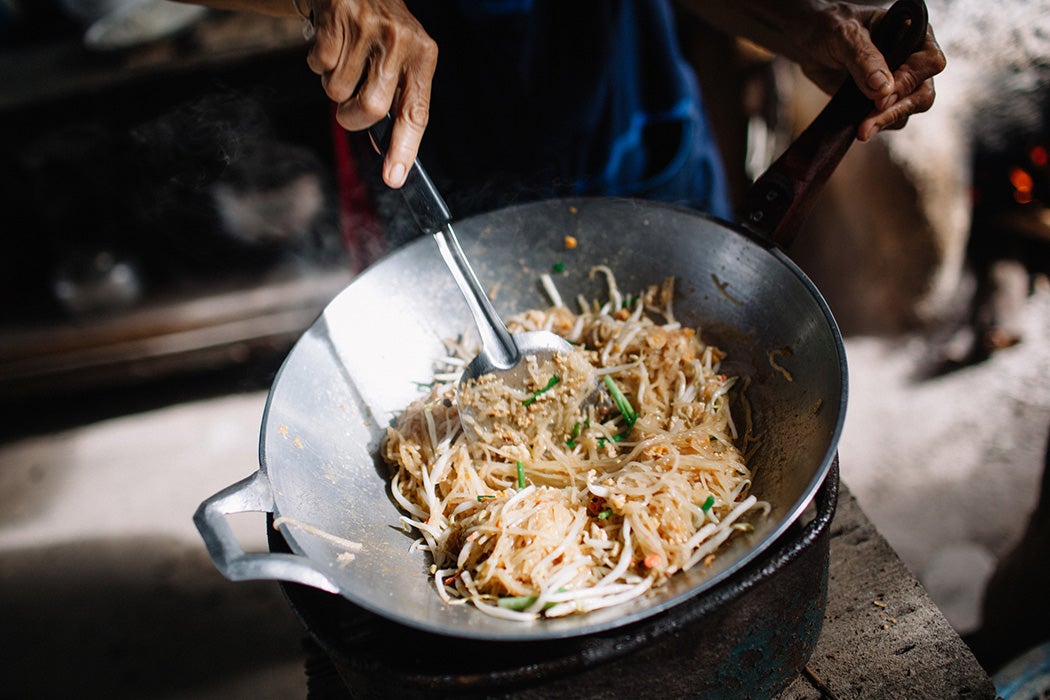
from JSTOR, nonprofit library for the intellectually curious A government campaign transformed a Chinese-inspired noodle dish into a symbol of Thailand’s national identity. A chef cooking Pad Thai in a small eatery in Kanchanaburi district, Thailand. The icon indicates free access to the linked research on JSTOR.
Pad Thai is among the most popular offerings at Thai restaurants all over the world, thanks to its distinctive yet approachable sweet-sour-savory flavor profile. But as food writer and critic Alexandra Greeley writes, it started out as a deliberately nationalistic dish. Greeley notes that it’s a bit of an odd choice for an iconic Thai food, since its cooking technique—stir-frying—and main ingredient—noodles—come from China.
People arriving from China’s Guangdong province probably put together the first dishes of stir-fried noodles, meats, and vegetables served in Thailand. Some vendors served the dish on a piece of banana leaf and wrapped it in newspaper for easy transportation. It was Thailand’s authoritarian mid-twentieth-century prime minister, Plaek Phibunsongkhram, usually known as Phibun in English, who created the pad Thai phenomenon.
Soon after he took office in 1938, he changed the country’s name from Siam to Thailand, meaning “land of the free.” During his time in office—all but four years from 1938 to 1957—he worked to modernize the country and create a “Thai Great Tradition” that would unify the country culturally and politically. Greeley writes that one move in this direction was creating a national dish containing nutritious ingredients like eggs, bean sprouts, and peanuts that could be bought from Thai farmers or produced in home gardens. The dish, kway teow pad Thai, meaning Thai-style stir-fried noodles and often shortened to “pad Thai,” incorporates the three flavors considered central to Thai cuisine—salty, sour, and sweet—as well as a fourth flavor, “spicy.” Texturally, the slight crunch of bean sprouts and peanuts complements the soft noodles and chewy shrimp.
Food in America is a living archive of exchange and adaptation, where “ethnic” cuisines blend and redefine what national identity tastes like. In the 1940s, there were major floods in Thailand, which led to disease outbreaks. With many people worried about the spread of germs, pad Thai was seen as a relatively safe food because it was served steaming hot.
The government shared a simple recipe for pad Thai with the public and encouraged vendors to set up shop using wheeled carts equipped with new and easily cleaned cooking tools so that the dish could be made to order. This field is for validation purposes and should be left unchanged. Get your fix of JSTOR Daily’s best stories in your inbox each Thursday.
Extract — continue reading at the source.
/https://tf-cmsv2-smithsonianmag-media.s3.amazonaws.com/filer_public/66/4b/664b2bd2-608d-4462-9b34-7fdd53e05421/iss072-e-29325.webp)