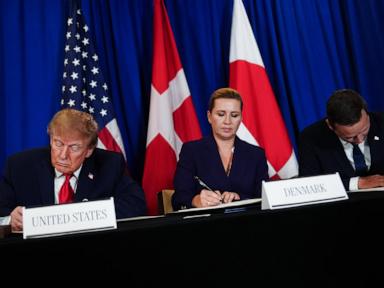
Iran has pushed back on claims that it dropped former preconditions for reopening the strait of Hormuz in surprise talks held in New York under the mediation of Qatar between Tehran’s foreign minister, Abbas Araghchi, and Donald Trump’s envoys Steve Witkoff and Jared Kushner. Trump said the three-hour talks held in a room at the UN headquarters had gone very well and been very productive. He suggested further talks were possible imminently, which led to the price of a barrel of Brent crude to fall to below $100 (£75) for the first time in two weeks.
Witkoff said the talks had been “encouraging, constructive and successful”. In his speech to the UN general assembly, Trump said he had a decision to make very soon on whether to “annihilate the Islamic Republic” or help turn it into one of the great countries of the Middle East, the kind of bombastic threat Trump often deploys during talks with Iran. In Tehran, the foreign ministry spokesperson, Esmail Baghaei, confirmed the talks had occurred, but appeared not to confirm any shift in the Iranian negotiating position.
He said: “The interaction that took place with the American side was through Qatari mediation. This interaction was aimed at conveying Iran’s conditions, including the end of the war in all its dimensions, the cessation of American aggressive actions, the naval siege, and the economic war, the release of Iranian assets and so on.” Aware of the potential domestic backlash, he added that Iran’s conditions had been conveyed. Iran set seven preconditions before returning to talks, and in a new development over the past 48 hours said the crucial strait of Hormuz could be reopened within seven days if those conditions were met.
It is likely that the US and the Gulf states would have to accept a navigational route for shipping in the strait of Hormuz – a key waterway for transporting oil – that requires commercial shipping to enter through a sea lane mainly in Iranian waters and under Iranian rather than Omani control. The fact that the talks lasted three hours suggests some progress was made. The US side is under pressure to leverage down oil prices and increase the availability of refined oil before the midterm elections in November.
Latest published figures suggest the number of identifiable tankers making it through the strait is fewer than five a day, but estimates of the US navy are much higher. The blockage in the strait is made worse by the uncertainty surrounding the control by the Houthis’ (the Iranian-backed Yemeni paramilitaries) of a second energy transport chokepoint, the Bab al-Mandab strait that leads from the Red Sea into the Indian Ocean. There is little sign that Trump wants to relaunch a full-scale war with Iran or indeed with the Houthis as Republicans battle to turn the domestic political agenda away from a hugely unpopular war that the Americans think they are losing.
Iran is under ever more intense pressure from sanctions, and a US naval blockade is making it nearly impossible for Iran to export oil, depriving the country of badly needed foreign currency. Iran’s civilian aircraft on Wednesday faced a potential worldwide grounding owing to the threat of US secondary sanctions on any entity that engaged with Iran’s civilian fleet. Iranian officials negotiated frantically with neighbouring countries to try to maintain an air bridge, but it appears Oman and Iraq have been forced to close their airspace to Iranian civilian planes.
Extract — continue reading at the source.